The Investigation Committee (IC) is one of the most powerful and consequential committees of ICAP. Its mandate is noble: protect the public interest, uphold professional standards, and enforce discipline.
However, when I reviewed ICAP's own Investigation Committee reports over the last ten years, one issue stood out clearly and consistently:
- •Chronic pendency of cases, year after year, with little structural improvement.
This is not an allegation. This is ICAP's own disclosed data.
The Numbers ICAP Publishes — But We Rarely Discuss
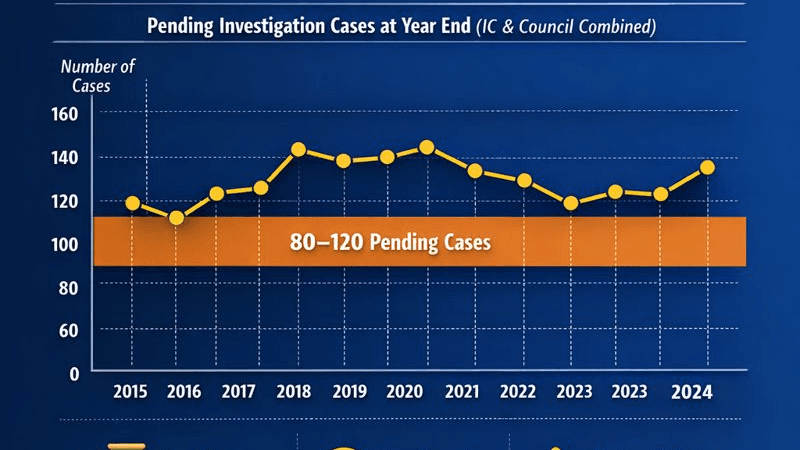
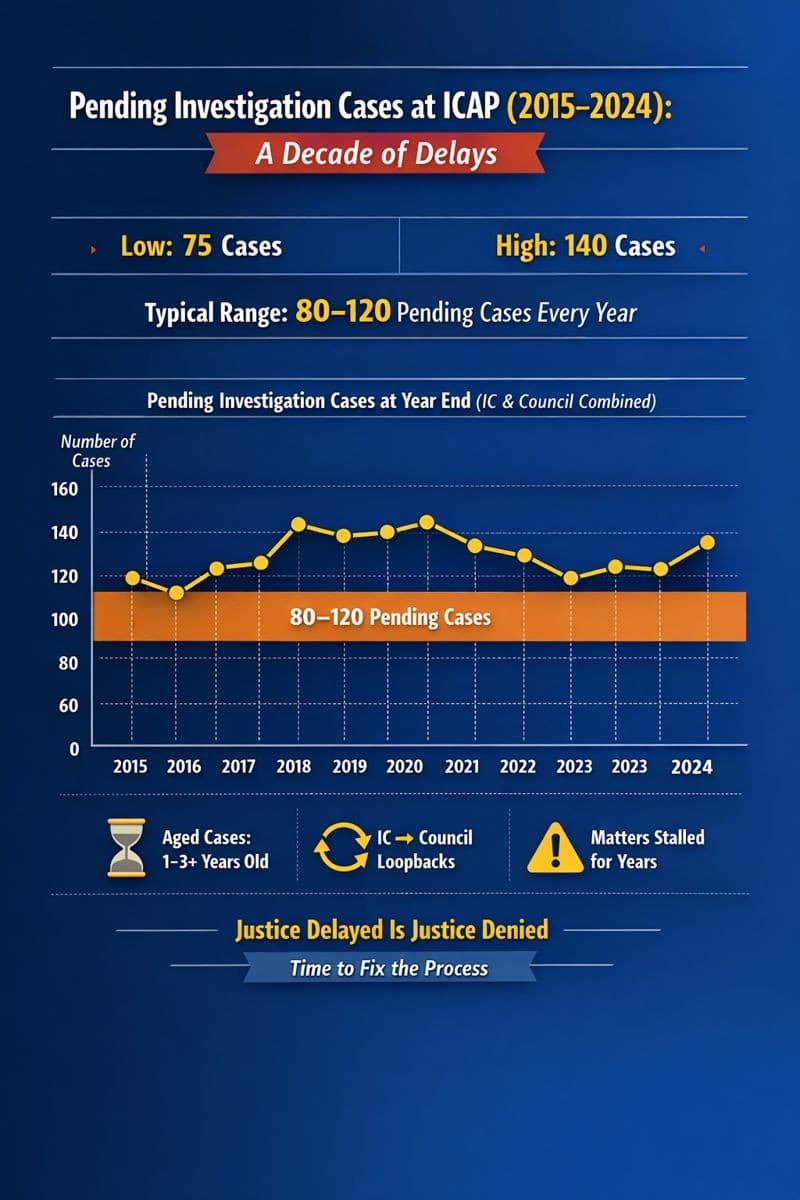
Across ICAP's Investigation Committee Annual Reports from 2015 to 2024, the following pattern emerges:
Cases Pending at Year End (IC + Council Combined)
- Lowest observed: ~75–80 cases
- Highest observed: ~130–140 cases
- Typical range: 90–120 cases pending at every year end
Despite:
- ✓ Multiple committee reconstitutions
- ✓ Additional independent members
- ✓ Repeated procedural refinements
- ✓ Rising examination and membership fee income
👉 The backlog does not structurally reduce.
A Simple Question
If 80–140 cases remain pending every year, then logically:
Either new cases ≈ cases disposed, or
Older cases are rolling forward year after year
Both scenarios point to systemic inefficiency, not individual failure.
Ageing of Cases: The Silent Red Flag
Several ICAP reports include a table titled "Ageing of Cases." What does it show?
- 📍 A material portion of cases pending for more than 1 year
- 📍 Some cases stretching into multiple years
- 📍 Matters moving between IC → Council → IC, increasing cycle time
This is not a court of law. This is a professional regulatory body. Yet delays comparable to litigation are normalized.
Why This Matters (Beyond Statistics)
1. Justice Delayed Is Justice Denied
For the complainant:
- • Delayed closure undermines confidence in the profession
For the respondent (member/student):
- • Career uncertainty
- • Reputational damage without adjudication
- • Mental and professional stress
In regulatory ethics, time itself becomes a penalty.
2. Investigation Should Not Feel Like Harassment
When matters:
- • Remain unresolved for years
- • Involve repeated notices and hearings
- • Lack defined closure timelines
The process starts feeling punitive, even before guilt is established. This perception — whether intended or not — damages trust in ICAP's governance.
3. IC Is a Core Committee — Not a Side Function
Investigation is not:
- ✗ A ceremonial committee
- ✗ A learning forum
- ✗ An honorary assignment
It is one of ICAP's most critical statutory responsibilities under the Chartered Accountants Ordinance, 1961. Backlogs at this level are governance failures, not administrative inconveniences.
A Global Reality Check
In many mature professional bodies:
- ⚡ Initial screening: days, not months
- ⚡ Minor matters: summary disposal
- ⚡ Clear SLAs: publicly disclosed
Delays beyond a reasonable period are treated as institutional risk. Why should ICAP be different?
What Reform Could Look Like (Practically)
I am not arguing for leniency. I am arguing for speed, fairness, and certainty.
Proposed Resolution Timelines
| Case Type | Suggested Closure Timeline |
|---|---|
| Prima facie review | 7–14 days |
| Minor / technical breaches | 30 days |
| Standard misconduct cases | 45–60 days |
| Exceptional / complex cases | Clearly justified extension |
Anything extending beyond this should:
- ✓ Be exception-based
- ✓ Be reported transparently
- ✓ Require documented reasons
Structural Improvements Worth Considering
Case Categorization at Intake
Not every complaint requires a full-scale investigation.
Fast-Track / Summary Disposal Mechanism
Many cases are procedural, not ethical fraud.
Hard Timelines for IC → Council Movement
Ping-ponging files increases ageing without adding value.
Public Disclosure of Pendency Metrics
Transparency drives accountability.
Annual Governance KPIs for Investigation Committee
Backlog reduction should be a measurable objective.
This Is About the Profession, Not Individuals
Let me be clear.
This is not an attack on:
- ✗ Any specific council
- ✗ Any specific committee member
- ✗ Any individual office bearer
This is a governance conversation — overdue, but necessary.
A strong profession is not one that punishes slowly. A strong profession is one that decides fairly and promptly.
Closing Thought
If:
- • 80–140 cases remain pending every year, and
- • Some matters stay unresolved for years,
then reform is not optional.
Justice delayed is justice denied — even in professional regulation. It is time to fix the process, not defend it.
Data source: ICAP Investigation Committee Annual Reports 2015–2024