Certainty in Risk, Truth in Virtue
A Synthesis of Andrey Kolmogorov’s Foundations of Probability and the Dialogues of Plato
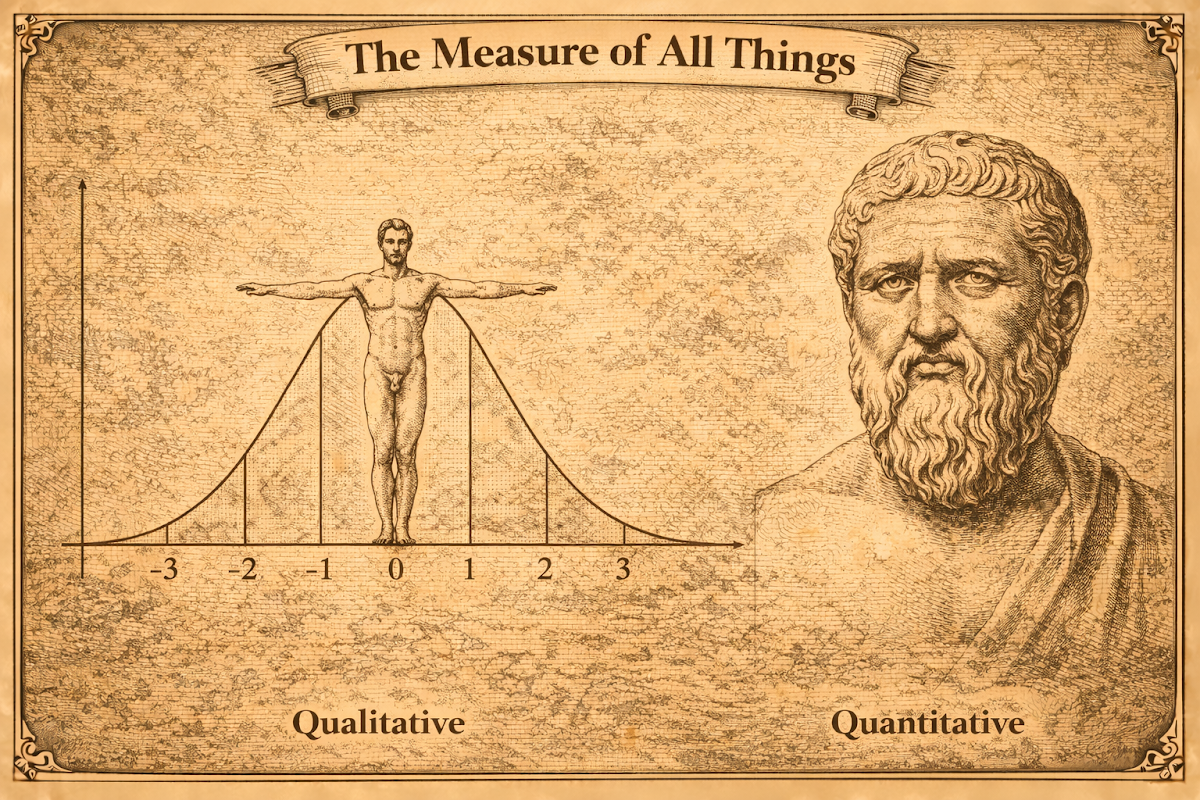
In an age that quantifies everything, from market crashes to election outcomes, from climate forecasts to personal health risks. We have grown accustomed to treating uncertainty as something measurable, tameable, even profitable. Yet the very grammar that lets us speak confidently about chance is less than a century old. In 1933, the Russian mathematician Andrey Kolmogorov published a slim monograph that transformed probability from vague intuition into rigorous mathematics. At almost the same historical distance lies another revolution: the Socratic demand, voiced across Plato’s dialogues, that we define our terms, especially the terms by which we claim to live well, before we dare to act.
This essay explores a deep and unexpected resonance between these two revolutions. Kolmogorov gave us axioms to measure the external world’s unpredictability; Socrates and Plato sought axioms to measure the internal world of character and choice. Both confronted circularity and sophistry in their respective domains. Both insisted that genuine knowledge requires a foundation that is not itself built on sand. And both, in the end, acknowledged limits of places where axioms give way to something less certain, yet no less necessary.
What follows is not a forced analogy but a disciplined comparison. Where Kolmogorov built a σ-algebra to contain events, Plato sought a “true name” to contain virtue. Where probability imposes a unit measure of 1 on the infinite possibilities of the sample space, Plato’s late dialogues impose measure and proportion on the unlimited flux of pleasure and pain. The parallels are striking, instructive, and perhaps urgently relevant to a civilization that excels at calculating risk but often falters at judging worth.
The Landscape of Confusion
Circularity and Sophistry Before the Foundations
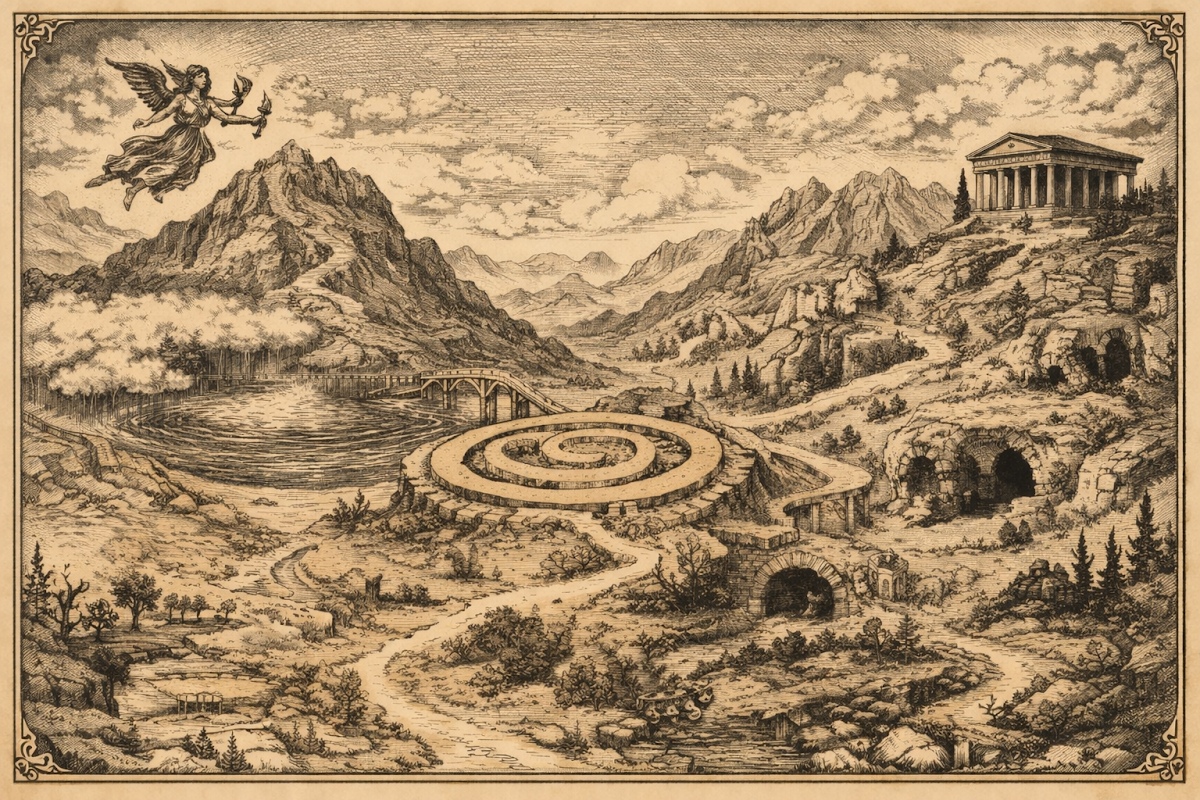
Before 1933, probability rested on a seductive but treacherous assumption: outcomes were “equally likely” unless we had reason to think otherwise. To define probability as the ratio of favorable to equally likely cases was to define it in its own terms as an elegant circle that dissolved under scrutiny. Without an independent foundation, probability remained a puzzle rather than a science. Practitioners could compute, but they could not justify.
A parallel confusion reigned in pre-Socratic Athens. The Socratic, itinerant teachers of rhetoric taught that truth was whatever persuaded an audience. In Plato’s Euthydemus, two sophists tie Socrates in verbal knots: a dog is a father, this dog is a father, therefore this dog is your father. The argument is formally flawless yet absurd. Without stable definitions of “father,” “dog,” or “yours,” language becomes a weapon rather than a tool of discovery. Virtue, justice, and the good life were similarly fluid, whatever the speaker could make an audience accept.
Both domains suffered from the same structural flaw: circularity masquerading as clarity. One used “equal likelihood” to define probability; the other used persuasive power to define truth. Neither could withstand sustained examination.
1933: The Axiomatic Turn
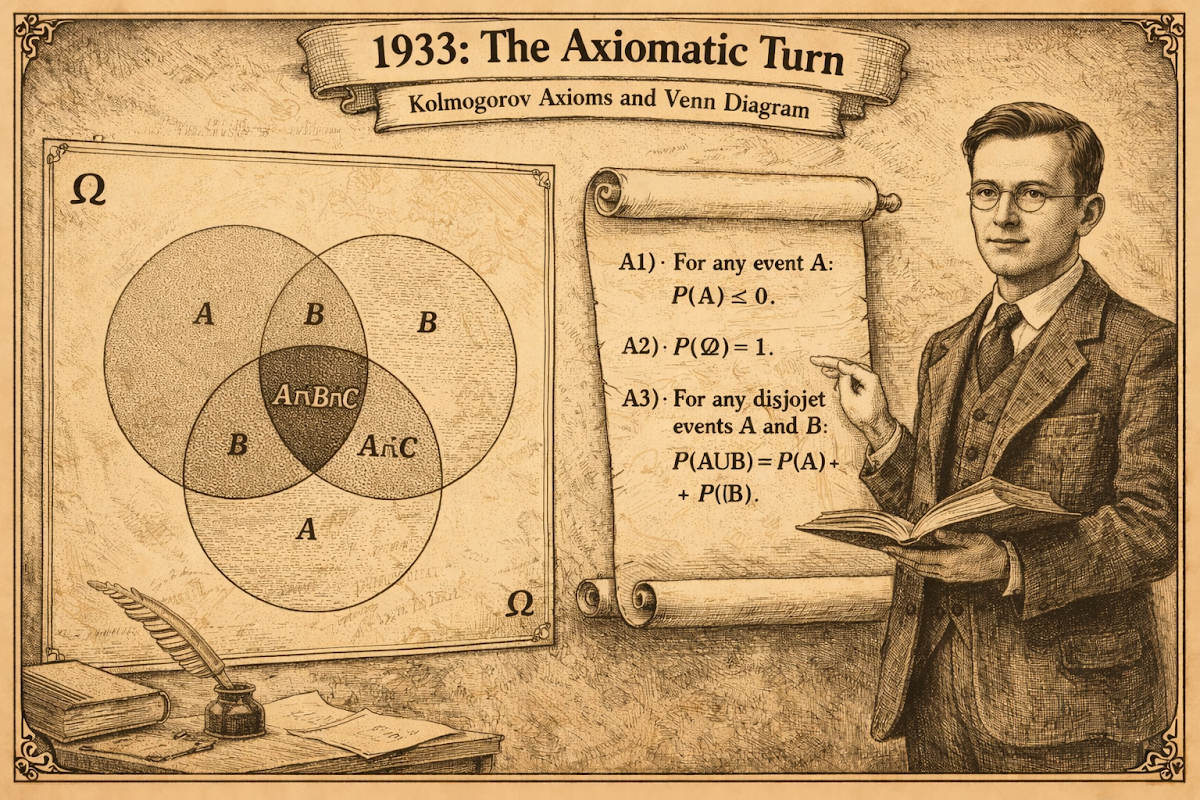
Andrey Kolmogorov’s *Grundbegriffe der Wahrscheinlichkeitsrechnung* (Foundations of the Theory of Probability) is only 60 pages long, yet it reshaped an entire discipline. Kolmogorov did not invent new theorems; he supplied the missing grammar. By embedding probability within measure-theoretic set theory, he provided four axioms that banished circularity:
1. Non-negativity: The probability of any event is greater than or equal to zero.
2. Normalization: The probability of the entire sample space is exactly 1.
3. Finite (later σ-) additivity: The probability of a countable disjoint union is the sum of individual probabilities.
4. Continuity from below (technical, but essential for bridging finite and infinite cases).
These axioms are austere, almost austere to the point of beauty. They say nothing about coins, dice, or “equally likely” outcomes. They simply describe a measure on a σ-algebra for a well-behaved collection of subsets of a space Ω. Everything else, random variables, expectation, laws of large numbers, follows as a theorem, not an assumption.
The effect was liberating. Probability became a branch of pure mathematics, applicable to continuous as well as discrete phenomena, to physics and finance, to information theory and machine learning. Uncertainty acquired a grammar.
The Socratic Turn
The Search for Definitions in the Soul
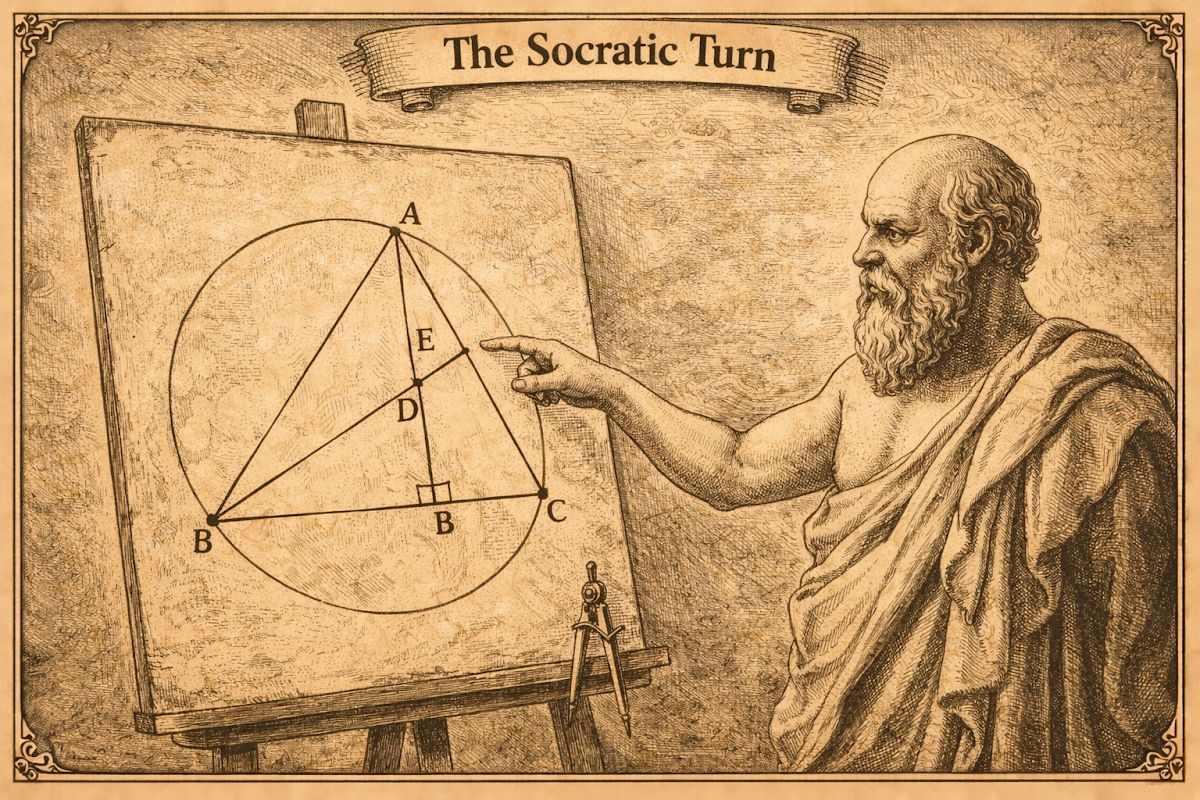
Socrates never wrote axioms, yet his method was no less revolutionary. In dialogue after dialogue Euthyphro, Laches, Charmides confronts interlocutors who claim to know what piety, courage, or moderation are. Each offers examples or conventional opinions; each is led, gently or ruthlessly, to contradiction.
Like Kolmogorov rejecting “equally likely” as foundational, Socrates rejects circular definitions of virtue. Piety cannot be defined as “what the gods love,” for then either the gods love it because it is pious (making piety prior) or it is pious because they love it (making piety arbitrary). The Euthyphro dilemma exposes the same kind of circularity that plagued pre-Kolmogorovian probability.
Socrates’ positive method is the dialectic in the disciplined pursuit of consistent definition. Reject doxa (mere opinion) and seek the eidos for the stable form or “idea” that allows consistent measurement of particular cases. Just as a σ-algebra lets us assign probabilities consistently to events and their combinations, a true definition of justice would let us measure actions consistently against an unchanging standard.
The Art of Measurement
The Finite and the Unlimited in the Philebus
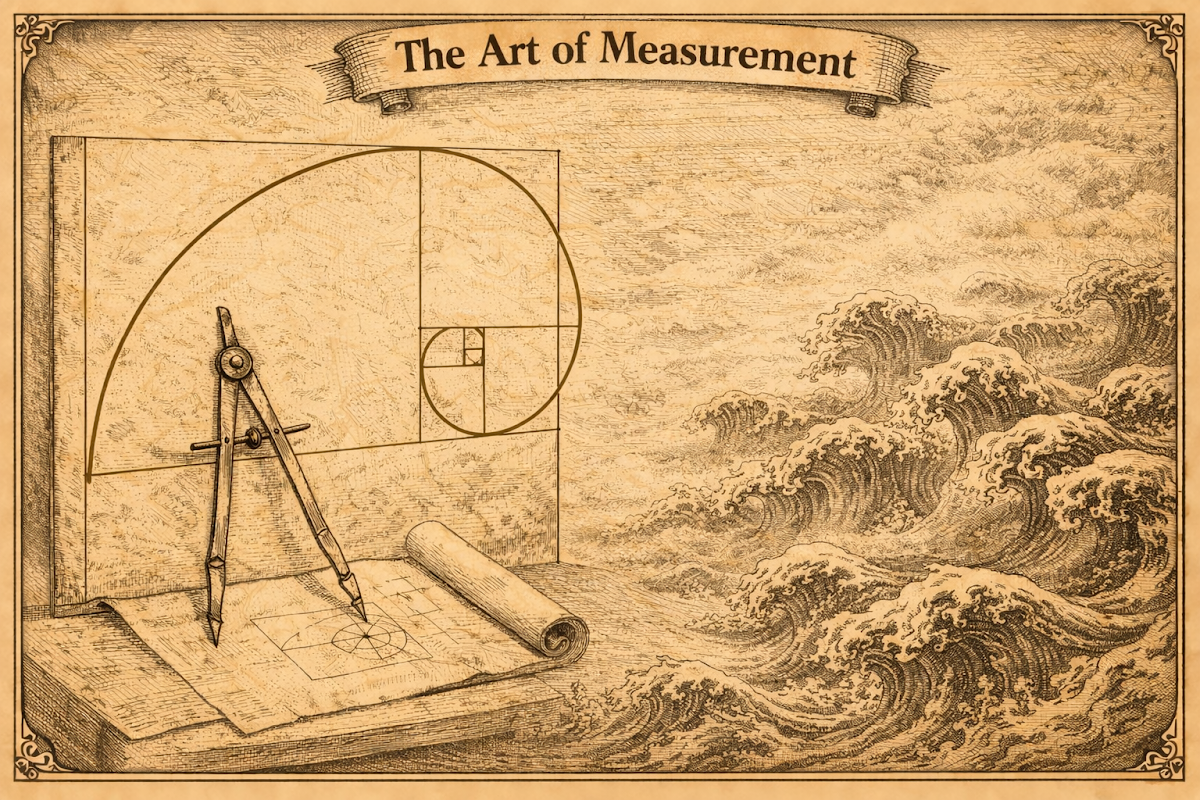
In one of Plato’s late dialogues, the Philebus, Socrates tackles the question of the good life head-on. Pleasure, he concedes, is real and powerful, but it belongs to the realm of the unlimited (apeiron) it admits of more and less without natural bounds. Reason, by contrast, belongs to the realm of limit (peras). The good life arises from their mixture under the guidance of measure and proportion. “The cause of the mixture,” Plato writes, “is beauty of form and virtue… The finite always introduces a limit, and perfects the whole frame.”
The parallel to probability is almost uncanny. The sample space of possible worlds is infinite and unbounded; the probability measure imposes a total of exactly 1, introducing limit where none existed. Measure perfects the frame, turning raw possibility into something we can reason about. Both Plato and Kolmogorov insist that the unlimited by itself is chaotic in pleasure without proportion, chance without measure. An order requires an external imposition of a limit.
Operationalising Chance
From Abstract Axioms to Concrete Action
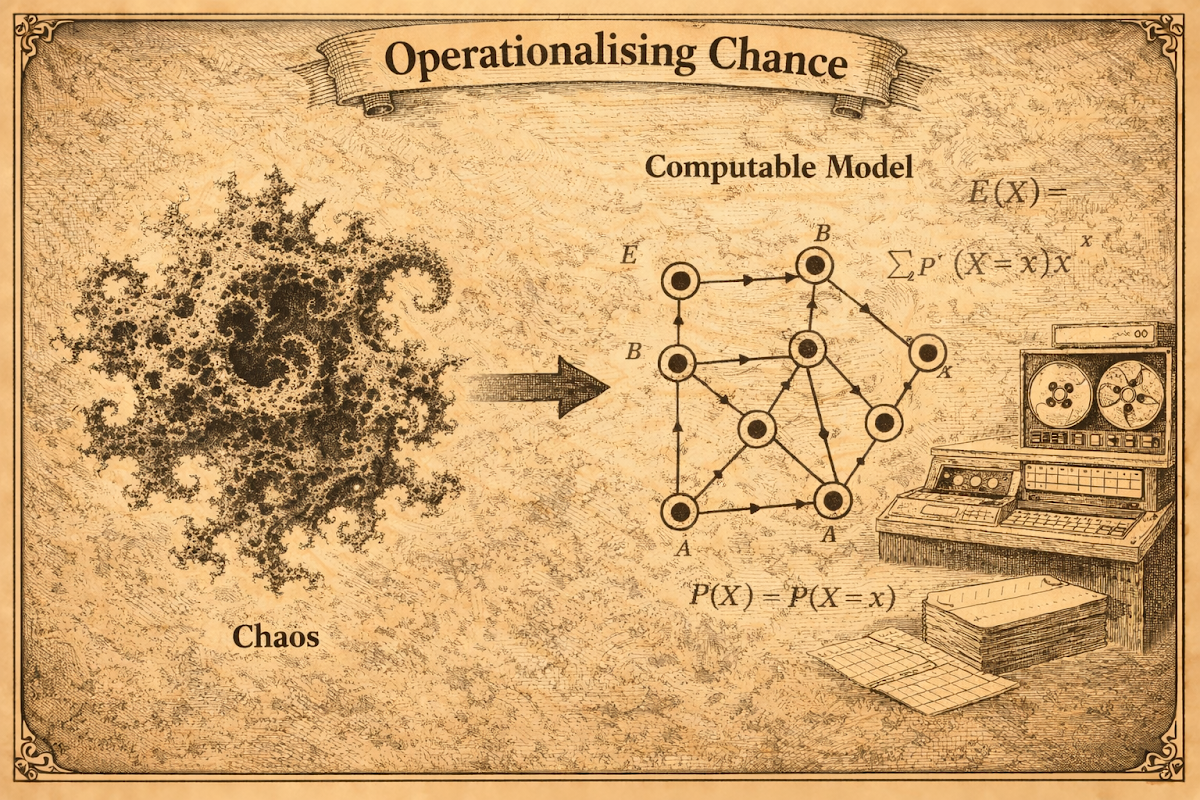
Kolmogorov’s axioms are abstract, yet they immediately enable practice. List all possible states (the sample space Ω). Define the events of interest (subsets in the σ-algebra). Assign a probability measure satisfying the axioms. Suddenly risk is no longer subjective unease; it is a computable quantity: Risk = Probability × Impact.
Modern tools, Value at Risk, stochastic processes, and Bayesian updating rest on this foundation. Probability has been domesticated; it is now a branch of pure mathematics that nevertheless powers trillion-dollar industries.
Plato seeks a parallel operationalisation of virtue. If we could define justice rigorously, we could measure actions against it, just as we measure financial positions against a probability distribution. The just soul, like a well-calibrated model, would respond appropriately to the stochastic impulses of appetite and spirit.
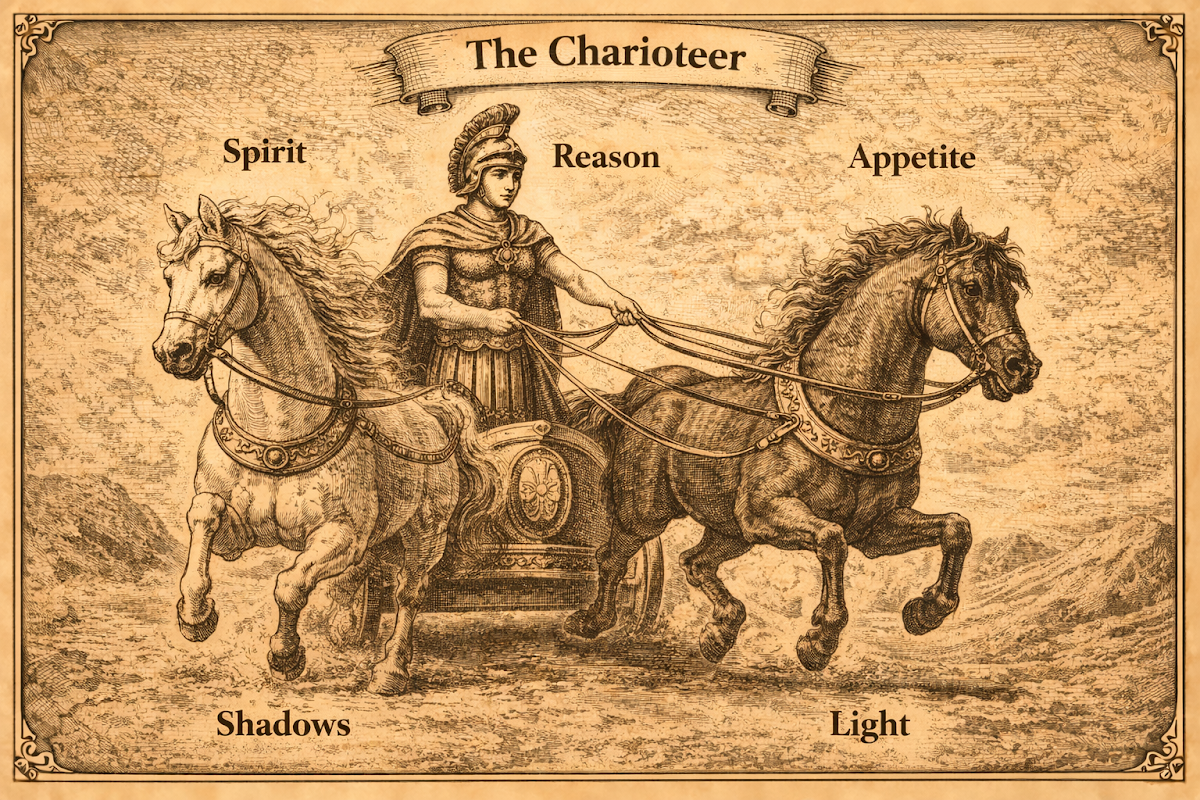
In the Phaedrus myth, Plato depicts the soul as a charioteer guiding two horses—one noble (spirit), one unruly (appetite). Virtue is the system state in which reason maintains control. It is not randomness suppressed but randomness governed.
Episteme vs. Doxa
The Threshold of Knowledge
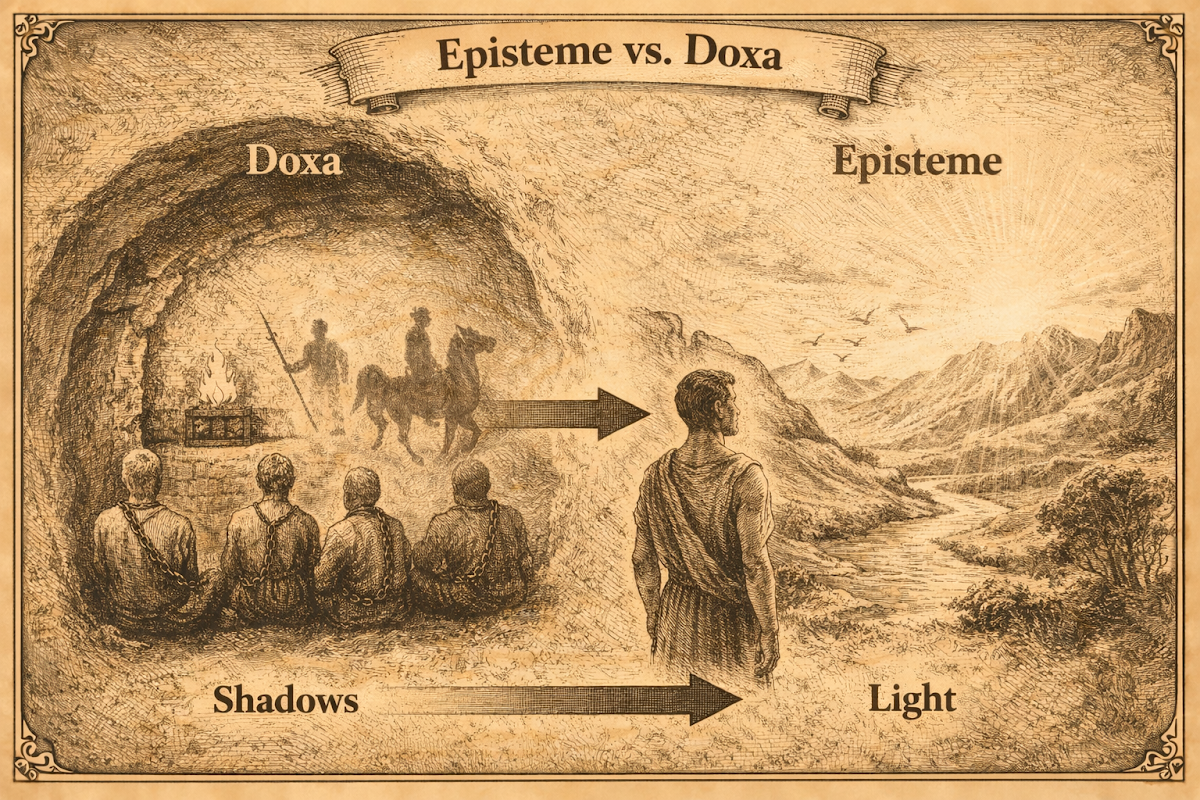
Kolmogorov separates stochastic risk (rigorously defined) from mere subjective unease. Plato separates episteme (knowledge grounded in definition and cause) from doxa (true opinion that happens to be correct but lacks grounding).
Both demand a movement from shadows to light. Intuition may serve in calm weather, but when the stakes are high in systemic financial crises, moral dilemmas under pressure, only rigorous foundations suffice.
When the Axioms Tremble
Limits of Dialectic and Non-Stochastic Randomness
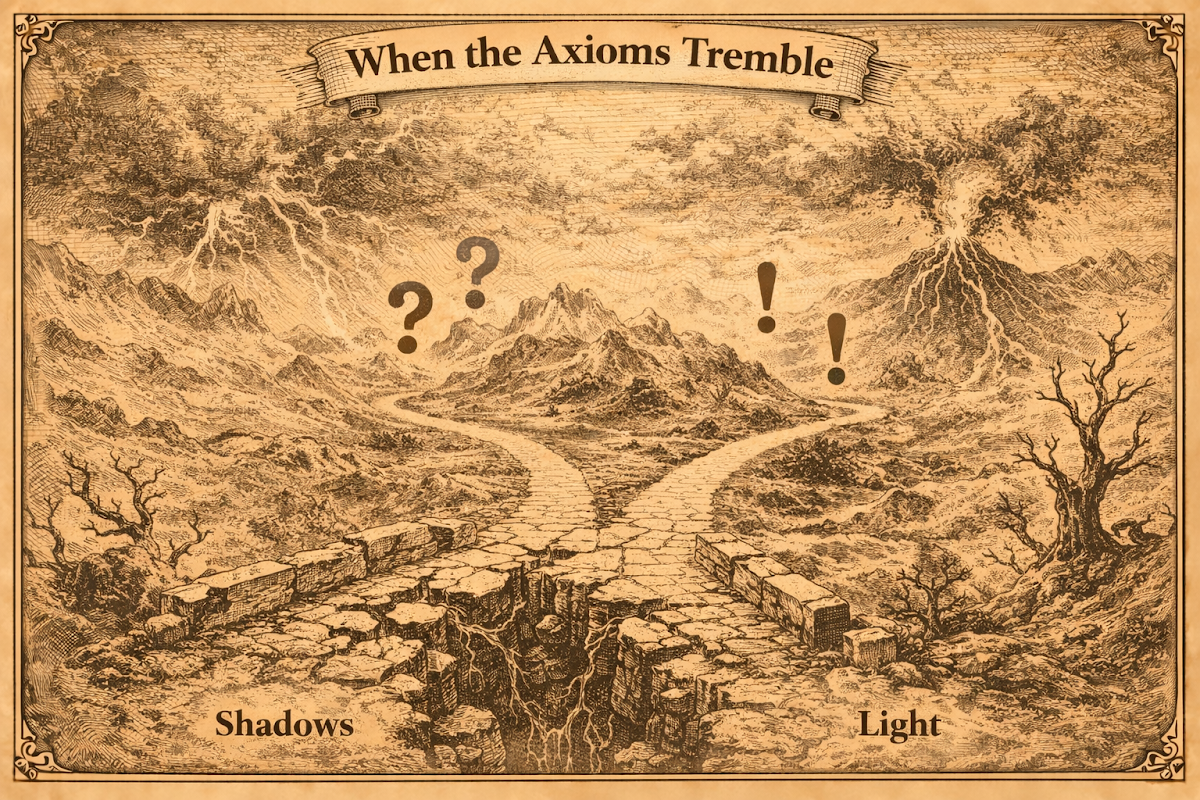
Yet both systems acknowledge limits. In probability, Knightian uncertainty arises when we cannot define a single measure—when model risk itself dominates. Climate tipping points, geopolitical ruptures, and true technological singularities resist probabilistic treatment. The response is robust decision-making under a set of plausible measures rather than a single “true” one.
In Plato’s Phaedo, Socrates confronts the ultimate uncertainty: death and the fate of the soul. Dialectic cannot prove immortality; logic falters at the boundary of the visible world. Socrates, therefore stakes his life on a “noble risk” a fair hope supported by myth rather than demonstration.
Modern risk managers use expert judgment when data run out; Plato uses myth when dialectic runs out. Both are honest acknowledgments that rigorous measures, however indispensable, is not exhaustive.
The Law of Large Numbers
The Judgment of Souls
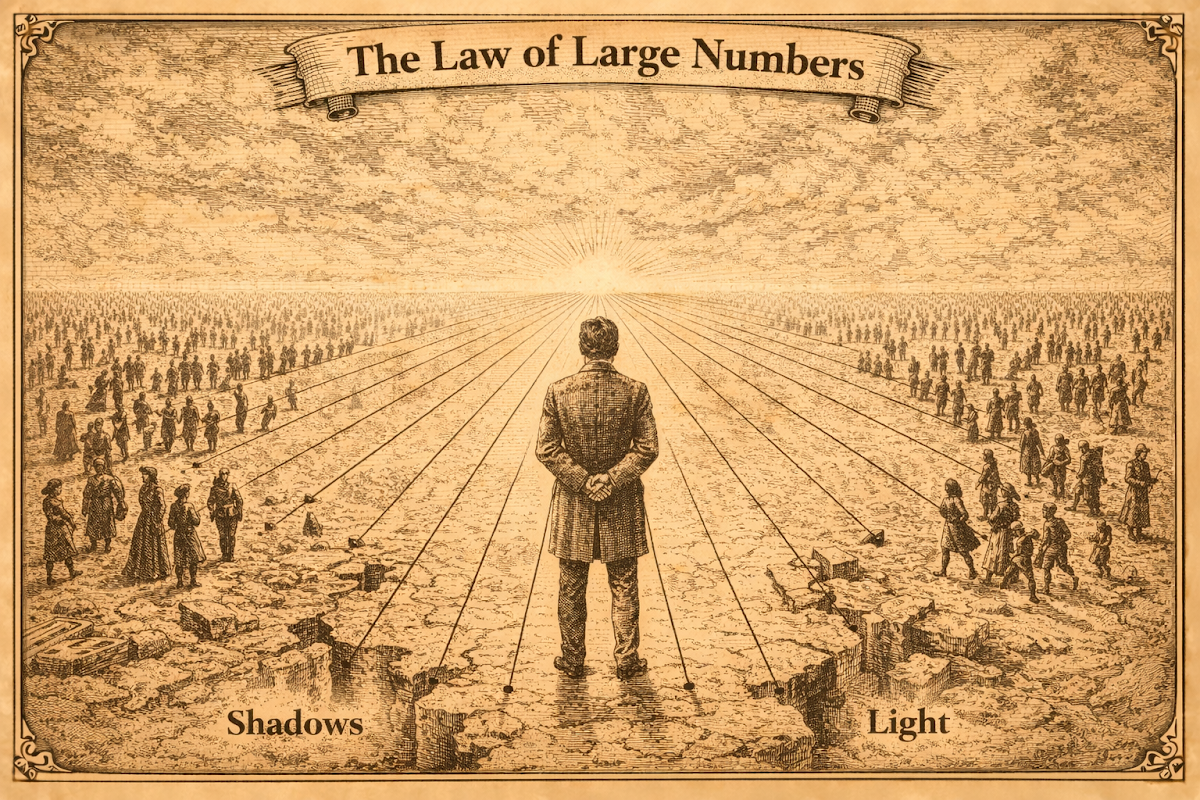
Kolmogorov’s probability theory culminates in the law of large numbers: in the long run, empirical frequencies converge to true probabilities. Short-run variation gives way to long-run stability.
In Plato’s Gorgias, the myth of posthumous judgment performs the same function. The soul, stripped of body and reputation, stands naked before judges who see the scars left by injustice and perjury. Death is the ultimate long run in the moment when the true distribution of character is revealed.
Both visions are austere and consoling. The world may be noisy, but there exists an underlying measure that repeated trials, or the trial of a lifetime, will eventually disclose.
Case Study. The Calculation of Socrates
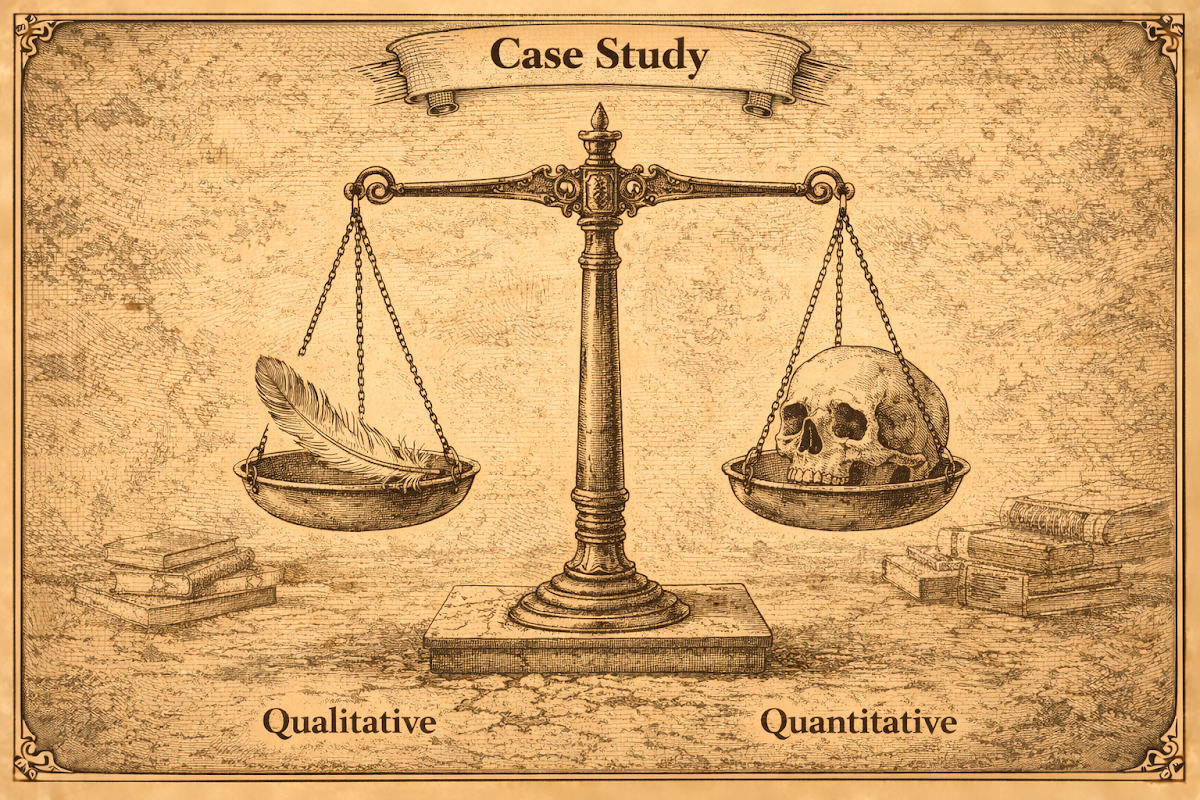
Socrates’ own death is the clearest illustration of measured choice under uncertainty. Escape would preserve the body but violate the laws (the axioms of the polis). Death destroys the body but preserves the soul’s integrity. Socrates weighs the outcomes and chooses consistency with his lifelong axioms: “The unexamined life is not worth living.” He accepts the negative physical outcome to remain aligned with the higher measure of the good.
The Legacy. Two Grammars for Reality
We inherit two indispensable grammars.
Kolmogorov’s grammar of uncertainty governs the external world: science, engineering, finance, and prediction. It is powerful, precise, and when misapplied becomes dangerous. A civilization that masters risk calculation but forgets virtue becomes a technocracy: efficient, perhaps, but brittle and sometimes cruel.
Plato’s grammar of meaning governs the internal world. Ethics, purpose, justice. It is difficult, contested, and when ignored, it becomes catastrophic. A civilization that cultivates virtue but neglects risk management is helpless against storms it could have foreseen.
The synthesis is not fusion but balance. We need both measure and meaning, both probability and proportion, both the rigor to calculate and the wisdom to know what is worth calculating. In an era of algorithmic governance and artificial intelligence, the ancient question returns with new urgency: Can machines learn measure without learning meaning? Can we build systems that quantify risk yet still recognize when the axioms themselves must be questioned?
Kolmogorov and Plato, speaking across two and a half millennia, remind us that genuine progress requires foundations, clear, consistent, and honestly acknowledged in their limits. Only then can we hope to measure not just the world, but the worth of our place within it.
Umer Ghazanfar Malik (UGM), PE, FCIArb
UNDP GPN ExpRes Global Consultant
Keywords
Kolmogorov, Plato, Probability Theory, Measure Theory, Epistemology, Philosophy of Risk, Law of Large Numbers, Ethics and Virtue, Foundations of Knowledge, Civilizational Thought, Justice, Proportion, Axiomatic Reasoning, UGM21
References and Bibliography
- Kolmogorov, A. N. Foundations of the Theory of Probability. Foundational work establishing the axiomatic basis of modern probability theory.
- Plato. Euthyphro. On definition, piety, and the problem of circular reasoning.
- Plato. Laches. On courage and the difficulty of defining virtue.
- Plato. Charmides. On temperance, measure, and self knowledge.
- Plato. Phaedrus. On the structure of the soul and disciplined reason.
- Plato. Phaedo. On death, philosophical courage, and the limits of argument.
- Plato. Gorgias. On rhetoric, judgment, and the moral evaluation of a life.
- Plato. Philebus. On limit and the unlimited, proportion, and the good life.
- Plato. Republic. On justice, the structure of the soul, and the ordering of the city.
- Plato. Apology. On Socratic inquiry, examined life, and principled judgment under uncertainty.
Interpretive Note
This article examines a deep structural parallel between two great civilizational grammars: Kolmogorov’s measure theoretic foundations for uncertainty and Plato’s philosophical search for stable definitions of virtue, justice, and the good. The argument is that probability and ethics are not identical domains, yet both require disciplined foundations if judgment is to rise above intuition, sophistry, and circularity.
Related Reading
- The Legal Spine: Why Civilizations Fail Without Codified Predictability
- The Ethical Regulator. Beyond the Mechanical Trap of Law and Logic
- Foundations of Wisdom From Ancient Ethics to Artificial Intelligence
- Collective Learning of Human Race
- Governance, Infrastructure, and Collective Learning in Complex Systems
Umer Ghazanfar Malik (UGM), PE, FCIArb
UNDP GPN ExpRes Global Consultant
Professional Civil Engineer, Arbitrator, and Infrastructure Governance Specialist working at the intersection of systems thinking, probability, law, ethics, and civilizational reasoning.