
Diagnostic Analysis: Neutralizing the Milli-hertz paper prison with a Giga-hertz Axiomatic Logic Spine.
The Algorithmic Judge
AI, Dispute Resolution, and the Axiomatic Turn
📄 Abstract
Manual arbitration operates at milli‑hertz cadence while modern infrastructure generates giga‑hertz data streams. This decoupling, termed as Litigation Phase‑Lag, acts as a Stagnation Tax, draining sovereign liquidity and weaponizing procedural delay. This article proposes the Axiomatic Turn: a shift from linguistic ambiguity to binary verifiable states, anchored by cryptographic integrity and overseen by a new professional of the Systems Arbitrator. Through the Turing Evidence Test and a real‑time Logic Spine, we can align legal verification with project velocity, reclaim the development axis, and transform justice from a post‑mortem exercise into a function of industrial momentum.
⚡ Executive Summary
- The Problem: Mega‑projects generate millions of telemetry points per second, yet dispute resolution relies on quarterly reports and years of discovery. The Evidence Horizon has collapsed; digital data is vulnerable to spoofing and retroactive manipulation.
- The Solution, Axiomatic Turn: Translate measurable obligations into binary verifiable states; embed a Logic Spine that ingests cryptographically signed telemetry; automate routine determinations while preserving human judgment for complex issues.
- The Operator, Systems Arbitrator: A new professional role combining forensic auditing with residual adjudication. Applies the Turing Evidence Test (source authentication, integrity verification, contextual consistency) to ensure data trustworthiness.
- The Impact: Neutralizes the weaponization of procedural delay; closes the enforcement gap; reclaims the Development Axis for the Global South; lowers risk premiums and accelerates infrastructure delivery.
- The Call: Mandate forensic integrity standards, invest in local capacity, pilot the model on strategic projects. The technologies exist—the sovereign will is the missing ingredient.
📑 Contents
I. The Diagnostic: The Failure of Manual Evidence Processing
The Milli‑Hertz Legal Engine vs. the Giga‑Hertz Matrix
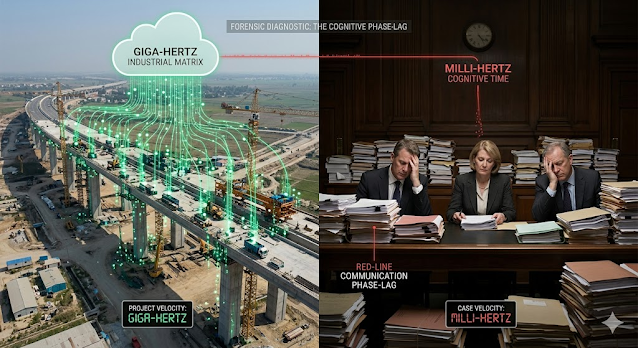
In the current landscape of international infrastructure, we are witnessing a complete decoupling of project reality from legal oversight. A modern mega‑project, a CPEC corridor, a Middle Eastern smart city, or a Central Asian logistics hub operates as a high‑frequency industrial matrix. Every sensor, drone, and supply‑chain node generates data in real time, often at rates measured in kilohertz or higher. (Refer to the article on my blogspot for the detailed back ground, Foundationd of wisdom blogspot.com/2026/02/foundations-of-wisdom-from-ancient.html)
The metaphor of frequency highlights a structural truth: the cadence of legal verification must eventually align with the cadence of project execution. Today, the gap between them acts as a stagnation tax, a hidden drain on national liquidity and sovereign development.
The Collapse of the Evidence Horizon
The “evidence horizon” is the window of time in which a fact remains verifiable and uncontaminated. In traditional arbitration, it was assumed that truth could be reliably reconstructed after the fact through witness memory, site diaries, and paper records. In 2026, that assumption is no longer tenable.
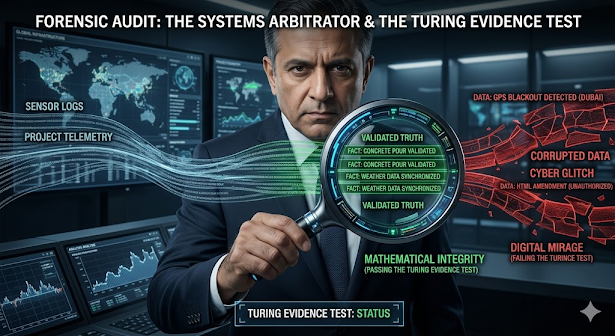
Recent incidents illustrate the fragility of digital evidence. In early 2026, a major infrastructure project in Dubai suffered a GPS spoofing attack that distorted telemetry across an entire construction zone. Concurrently, unauthorized HTML amendments were detected in cloud‑based project‑management platforms, small, targeted changes that retroactively altered milestone logs. These “digital mirages” are not hypothetical; they are active vectors of evidentiary manipulation.
When evidence is not captured, cryptographically anchored, and verified synchronously with the event, it ceases to be reliable evidence and becomes a narrative, a story that can be rewritten by whichever party controls the data layer. The evidence horizon, once measured in months, has now collapsed to hours or minutes.
The Turing Evidence Test: A New Forensic Threshold
To reclaim the integrity of the record, we must introduce a new forensic standard: the Turing Evidence Test. Unlike its namesake, this is not a test of whether a machine can imitate human behavior. Rather, it is a protocol for determining whether a digital record can be accepted as authentic, reliable, and unmanipulated EVIDENCE regardless of whether it was generated by a human, a sensor, or an AI.
In practice, the Turing Evidence Test asks three questions:
- Authenticity: Can the data be cryptographically traced to a known source (e.g., a signed sensor, a verified user) without evidence of tampering?
- Integrity: Does the data survive cross‑verification against independent telemetry streams (e.g., GPS, video, supply‑chain logs)?
- Contextual consistency: Does the data align with the physical reality it purports to represent, or does it exhibit signs of algorithmic hallucination or deliberate spoofing?
An arbitrator’s role in 2026 must therefore begin before the substantive hearing. The tribunal, or a newly conceived “systems arbitrator,”—must act as a forensic auditor, assessing the evidentiary foundation upon which any machine‑assisted or human decision will rest. Unless a project’s digital heartbeat is anchored by a sovereign logic spine that performs real‑time integrity checks, the entire evidence base remains vulnerable to the digital mirage.
Why Manual Processing Cannot Be Scaled
Even if evidence integrity is assured, the manual review of that evidence remains a losing battle. A single week of construction on a major infrastructure project can generate millions of telemetry points, thousands of photographs, and hundreds of communications. A human legal team, no matter how skilled, cannot synthesize that volume in a timeframe that matches project needs.
The result is that disputes are resolved not on the basis of the ground truth captured at the time, but on a drastically reduced subset, emails, selected logs, and testimony filtered through memory and advocacy. This creates what can be called retrospective drift: the gap between what actually happened and what the tribunal is able to consider grows wider with every passing month.
High‑velocity justice does not demand that humans process gigahertz data streams. Instead, it demands that we offload the routine, verifiable, binary aspects of contractual performance to machine logic, reserving human judgment for the complex, the ambiguous, and the truly consequential. That transition, from manual interpretation to computational verification, is the subject of the next section.
II. The Axiomatic Turn: From Interpretation to Computation
If Section I diagnosed the failure of manual evidence processing, Section II proposes the remedy: a structural realignment of how contractual obligations are expressed, verified, and enforced. We call this the Axiomatic Turn.
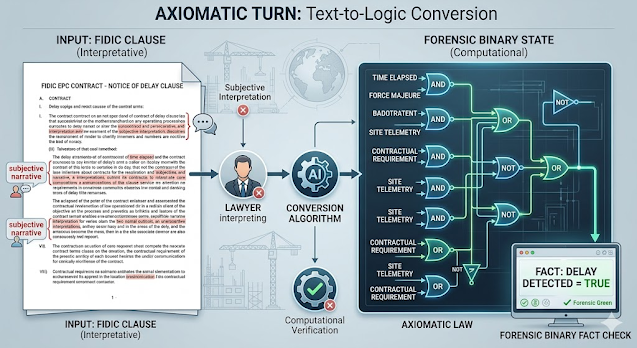
In traditional contracting, obligations are drafted as natural‑language prose, rich in context but also rich in ambiguity. A clause that requires “best efforts” or “reasonable skill and care” is not a statement of fact but an invitation to interpretation. In a high‑velocity industrial environment, such linguistic grey zones become strategic battlegrounds. Legal teams profit from prolonged debate while the project stalls.
The Axiomatic Turn does not seek to eliminate language or human judgment. Rather, it acknowledges that a significant subset of contractual obligations, those involving measurable milestones, verifiable events, and objective performance criteria, can be expressed as binary verifiable states. A foundation pour either occurred within the specified tolerances, or it did not. A payment either was received by the due date, or it was not. When these states are captured by independent, cryptographically secured sensors and telemetry, the question shifts from what did the parties intend? to what does the data show?
This is not a claim that all contractual disputes can be reduced to binary logic. Force majeure, design adequacy, and sovereign interference, these will always require human judgment informed by context, narrative, and often competing interests. But the routine, the measurable, and the verifiable can be automated. By isolating these elements, we liberate human decision‑makers to focus on the genuinely complex.
Kolmogorov Complexity as a Guiding Metaphor
In algorithmic information theory, the Kolmogorov complexity of an object is the length of the shortest program that can produce it. Applied metaphorically to disputes, it suggests that the simplest, most compressed description of a conflict is the underlying data itself, not the thousands of pages of submissions, witness statements, and legal argument that accumulate in traditional arbitration.
Consider a delay dispute. In the manual model, a ten‑day delay can generate ten thousand pages of filings. Each side constructs narratives around who caused what, when, and why. The original telemetry, GPS tracks of equipment, automated daily progress logs, and time‑stamped material deliveries are buried under linguistic noise. By the time a tribunal renders a decision, the dispute has grown in cost and complexity far beyond the value of the original issue.
The Axiomatic Turn treats the data as the primary reference. When contractual milestones are tied directly to a real‑time logic spine, the “algorithmic seed” of a dispute, the objective fact of whether a milestone was achieved, is identified immediately. The procedural fog that inflates cost and duration has no time to settle. This does not mean disputes disappear; it means they are prevented from metastasizing.
The Logic Spine: Executable Contracting
At the heart of the Axiomatic Turn is the concept of a logic spine, a layer of software that sits between the project’s digital twin (sensors, drones, supply‑chain systems) and the contractual framework. The logic spine performs two functions:
- Verification: It ingests telemetry and other cryptographically signed data, compares it against predefined milestone criteria, and determines whether each binary verifiable state is true or false.
- Execution: Based on those determinations, it can automatically trigger pre‑agreed consequences—release of payments, issuance of notices, or escalation of unresolved issues to human review.
Crucially, the logic spine does not render “arbitral awards” in the traditional sense. Instead, it implements the parties’ advance agreement that certain factual determinations, when derived from authenticated data, shall be conclusive. This is closer to automated contract performance than to autonomous adjudication. Parties retain the right to challenge a determination through expedited human review—but the burden shifts: to prevail, the challenging party must demonstrate either a failure in the data integrity or a fundamental error in the logic spine’s configuration.
The Integrity Prerequisite: Anchoring Data to Truth
The Axiomatic Turn can only succeed if the data feeding the logic spine is trustworthy. Section I introduced the Turing Evidence Test as a forensic protocol for assessing digital evidence. Here, that protocol becomes operational.
For routine verifiable states, milestone completion, equipment usage, material deliveries—the logic spine should rely on data that is:
- Cryptographically signed at the point of origin (sensor, authorized user);
- Hashed and timestamped to an immutable ledger, preventing retroactive alteration;
- Cross‑verified against independent sources (e.g., GPS, video, supply‑chain manifests) to detect spoofing or systemic error.
When these measures are in place, the “digital mirage” described in Section I is effectively neutralized for the classes of data that matter most. The evidence horizon no longer collapses because the evidence is anchored at the moment of creation, not reconstructed years later.
This does not eliminate the need for human forensic oversight. Systems arbitrators will periodically audit the integrity layer, sample telemetry streams, and investigate anomalies. But the cadence of that audit can be aligned with project rhythms rather than with the glacial pace of litigation.
From Adjectives to Integers: Reclaiming the Development Axis
The Axiomatic Turn replaces the adjective with the integer. Where traditional contracts invite subjective debate over words like “prompt,” “adequate,” or “reasonable,” the logic spine operates on objective, machine‑verifiable states. This shift has profound implications for sovereign development.
For states in the Global South, infrastructure projects often become entangled in protracted disputes that drain national liquidity and stall industrial momentum. The stagnation tax, the cost of delay, frozen capital, and diverted attention—is borne not by the legal industry but by the citizens awaiting roads, power, and ports. By adopting a framework that automates the verifiable and accelerates resolution, these states can reclaim what this article calls the development axis: the ability to govern project execution at the speed of construction, not at the speed of litigation.
This is not a rejection of international arbitration or the rule of law. It is an evolution—one that recognizes that in a world of giga‑hertz data streams, the legal infrastructure must finally catch up.
The Boundary of the Axiomatic Turn
No system can automate its way out of all conflict. The Axiomatic Turn is not a panacea. It applies cleanly to:
- Milestone‑based payments
- Time‑based delays (when measured by objective telemetry)
- Resource utilization (equipment hours, material quantities)
- Notification and procedural deadlines
It does not replace human judgment in:
- Design adequacy or workmanship quality (except where measurable standards exist)
- Force majeure and unforeseen site conditions
- Sovereign acts or regulatory changes
- Claims involving fraud, corruption, or willful concealment
For these categories, the logic spine acts as a transparent evidence repository, preserving ground truth for later human adjudication. The arbitrator’s role thus bifurcates: routine matters are resolved through automated logic; complex matters are illuminated by a verified evidentiary record that eliminates the retrospective drift that plagues manual arbitration.
III. The Systems Arbitrator: The Turing Evidence Test and the Forensic Mandate
If the Axiomatic Turn restructures how contractual obligations are expressed and verified, it also demands a new kind of legal professional, one who is equally comfortable with forensic technology, cryptographic integrity, and the high‑stakes context of sovereign infrastructure. We call this professional the Systems Arbitrator.
The Systems Arbitrator is not a replacement for the traditional arbitrator. Rather, the role evolves: from a generalist who receives retrospective narratives, to a specialist who oversees the integrity of a real‑time evidentiary ecosystem. In the model proposed here, the Systems Arbitrator does not sit passively waiting for a dispute to ripen. Instead, they are embedded—conceptually if not physically, in the project’s logic spine, performing continuous forensic oversight while reserving final judgment for the issues that truly require human wisdom.
The Obsolescence of the Manual Gavel
The traditional gavel symbolizes a form of justice that is deliberative, retrospective, and human‑paced. In an era of giga‑hertz data streams and collapsed evidence horizons, that symbol no longer fits. A gavel struck years after a project event does not resolve the dispute—it merely concludes a process that has long since lost relevance to the project’s actual condition.
This is not to say that the gavel has no place. Human judgment remains indispensable for questions of intent, reasonableness, and equity. But when a dispute turns on a binary verifiable state—whether a milestone was achieved, whether a payment was made—the gavel’s cadence is a liability. By the time it falls, the evidence horizon has already dissolved, and the cost of delay has often exceeded the value of the claim.
The Systems Arbitrator therefore replaces the gavel, as a primary instrument, with the forensic audit. Their mandate is not to wait for conflict to crystallize, but to ensure that the evidentiary foundation of the project remains intact from the first day of construction.
The Turing Evidence Test: From Theory to Protocol
Section I introduced the Turing Evidence Test as a conceptual threshold. Here, we operationalize it. The Turing Evidence Test is the protocol by which a Systems Arbitrator determines whether a digital record be it sensor telemetry, a signed document, or a communication log which can be accepted as authentic, reliable, and unmanipulated.
The test comprises three layers, each supported by cryptographic and forensic tools:
- Source Authentication – Was the data cryptographically signed at the point of origin? Does the signature correspond to a verified device or authorized user? Is the signing authority documented in the project’s governance framework?
- Integrity Verification – Has the data been stored in an immutable, append‑only ledger (e.g., a blockchain or secure timestamping service)? Do independent cross‑checks (e.g., GPS vs. video, equipment logs vs. fuel consumption) corroborate the record? Are there any unexplained gaps, timestamp anomalies, or signs of retroactive modification?
- Contextual Consistency – Does the data align with the physical and operational reality it purports to represent? Are there indicators of sensor drift, spoofing, or systemic error? If the data originates from an AI or automated system, does it fall within defined confidence thresholds, and is the model’s provenance documented?
When a record passes all three layers, it is presumed reliable for the purpose of triggering automated contractual consequences or informing human judgment. When it fails, the Systems Arbitrator investigates, and if the failure reveals systemic vulnerability, the logic spine may be temporarily suspended until integrity is restored.
This protocol transforms the evidence horizon from a fragile window into a continuously maintained asset.
The Dual Role: Auditor and Arbitrator
The Systems Arbitrator operates in two distinct capacities, each with its own temporal rhythm.
1. Continuous Forensic Auditor
In this capacity, the Systems Arbitrator does not decide disputes but ensures the conditions for trustworthy dispute resolution. Their responsibilities include:
- Certifying that the logic spine’s data sources meet the Turing Evidence Test criteria;
- Conducting random or targeted audits of telemetry streams;
- Investigating anomalies flagged by the logic spine’s automated integrity checks;
- Issuing forensic reports that become part of the project record.
This auditing function is preventive. It identifies evidentiary vulnerabilities before they can be weaponized in a dispute. It also provides parties with real‑time assurance that the ground truth is being preserved.
2. Adjudicator of Residual Disputes
When a dispute involves issues that cannot be resolved through binary verifiable states—such as force majeure, design adequacy, or allegations of bad faith for the Systems Arbitrator dons the traditional adjudicative mantle. However, unlike in manual arbitration, they do so with a verified evidentiary record that has been continuously maintained. The retrospective drift that plagued earlier models is eliminated because the data were never allowed to degrade or be manipulated.
In this adjudicative role, the Systems Arbitrator’s decisions are rendered in the traditional form: reasoned awards that can be enforced under the New York Convention. The difference lies in the speed, accuracy, and trustworthiness of the evidentiary foundation, not in the fundamental nature of arbitral authority.
Liability, Due Process, and the Limits of Automation
A critical objection to any model involving automated logic is: who is liable when the machine errs? The framework proposed here addresses this through clear allocation of responsibility.
- Data Integrity: The parties, through the project’s governance documents, select the cryptographic and forensic standards. If a data source fails the Turing Evidence Test because of inadequate security measures, the party responsible for that source bears the consequences.
- Logic Spine Configuration: The logic spine’s rules are programmed based on the parties’ contractual definitions. Any ambiguity in those definitions is resolved by the Systems Arbitrator before automation begins. Errors in configuration are treated as errors in contract interpretation, subject to human review.
- Automated Determinations: Determinations generated by the logic spine are not final awards. They are pre‑agreed contractual self‑executing mechanisms. Either party may challenge a determination by invoking expedited review before the Systems Arbitrator. During that review, the challenged determination is suspended pending human resolution.
This structure preserves due process: no party is bound by a machine’s decision without the opportunity for human scrutiny. Yet the default, swift execution based on verified data creates powerful incentives to resolve challenges quickly and to maintain accurate systems.
The 1% Rule: Human Judgment in the Giga‑Hertz Era
A common fear is that the Systems Arbitrator reduces human judgment to a vanishing point. The opposite is true. By offloading the routine, the verifiable, and the binary to machine logic, the Systems Arbitrator is liberated to focus on the small percentage of issues that genuinely require human insight, what we call the 1% rule.
These are the issues that involve:
- Sovereign intent and public policy;
- Complex causation and apportionment of fault;
- Allegations of fraud or corruption;
- Equitable considerations that cannot be reduced to algorithmic rules.
On these matters, the Systems Arbitrator’s judgment is not diminished; it is elevated. Freed from the cognitive burden of sifting through terabytes of routine data, they can devote their expertise to the nuances that define fair and sustainable outcomes.
Sovereignty, Competence, and the New Legal Profession
For the Global South, the emergence of the Systems Arbitrator represents an opportunity to build local capacity in a field that has historically been dominated by a handful of global legal centers. The skills required, forensic auditing, cryptographic literacy, project management, and traditional arbitration expertise, are teachable and can be cultivated within national institutions.
By hosting the logic spine locally and training Systems Arbitrators from within the region, states can reduce their dependence on foreign arbitral institutions for routine disputes, while retaining access to international expertise for complex matters. This is not isolationism; it is strategic capability‑building.
The Systems Arbitrator is not a futuristic abstraction. The technologies required, cryptographic signing, immutable ledgers, and real‑time telemetry integration, are commercially available today. What is lacking is the professional framework and the sovereign will to adopt it. Section IV addresses how this framework neutralizes the litigation phase‑lag and transforms justice from a post‑mortem exercise into a function of industrial momentum.
IV. Neutralizing the Litigation Phase‑Lag
In the Global South, wait and see is a terminal strategy. High‑velocity infrastructure corridors cannot survive the weaponization of procedural delay, a sophisticated form of industrial attrition where the objective is no longer the resolution of a technical point but the systematic exhaustion of the opposing party’s liquidity.
Traditional international arbitration allows well‑capitalized entities to create a tactical siege. By stretching a dispute over several fiscal years, these parties can force smaller local contractors or even sovereign states into unfavorable settlements simply because the cost of waiting for a manual award exceeds the value of the claim itself. This predatory use of phase‑lag ensures that the party with the deepest pockets dictates the terms of justice, effectively turning the legal process into a tool of economic subjugation.
Closing the Enforcement Gap
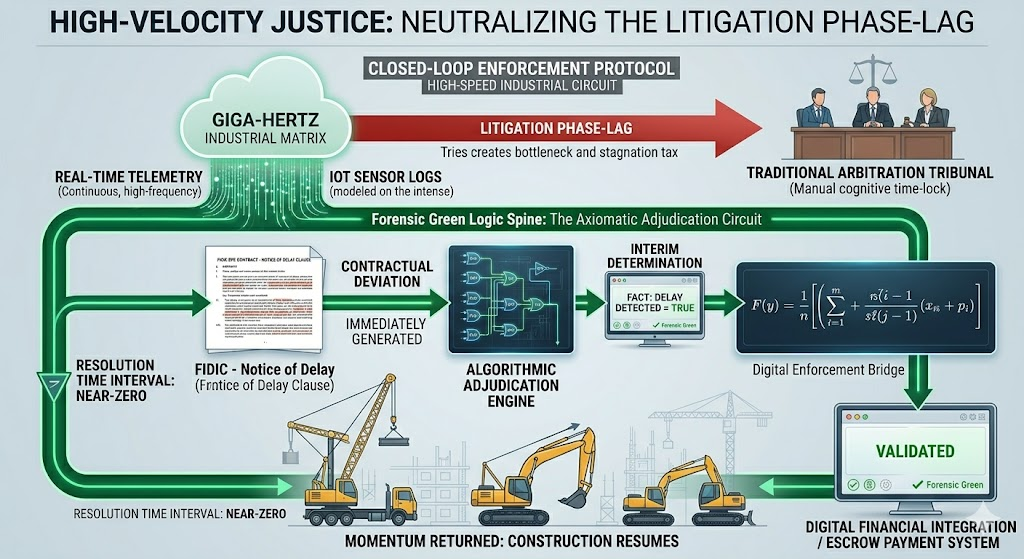
High‑velocity justice fundamentally neutralizes this weapon by collapsing the timeline of adjudication into a singular, synchronous event. When the resolution of a contractual deviation is made instantaneous through the logic spine, the strategic utility of creating a dispute for the sake of delay vanishes. In a high‑velocity system, there is no “dark period” where capital can be frozen or project momentum can be stalled for years.
Because the logic spine identifies and settles technical frictions at project cadence, the tactical incentive to obstruct progress is engineered out of the industrial matrix. We move from “litigation as combat” to “execution as compliance.” The enforcement gap—the distance between a legal decision and the actual recovery of assets—is closed by linking the logic layer directly to the project’s financial and operational systems under pre‑agreed contractual authorities.
Reclaiming the Stagnation Tax
The billions currently lost to the stagnation tax of slow arbitration represent a massive transfer of wealth from developing nations to global legal hubs. Every day a crane stands idle is a day of lost GDP. High‑velocity justice is the tax cut the Global South needs to accelerate its industrialization. By reducing the friction of dispute, we lower the risk premium that international contractors charge, leading to more competitive bidding and more efficient capital allocation—a hypothesis that warrants piloting on strategic projects.
For states like Pakistan, and other Global South Nations or those within the Central Asian markets, adopting this framework is a strategic shortcut. Rather than attempting to replicate expensive and often misunderstood manual human‑adjudication boards, they can leapfrog directly into synchronous resolution. If the duration required to resolve a dispute is reduced to near‑zero for verifiable matters, the concepts of “legal battle” and “procedural delay” become obsolete. There can be no battle where there is no terrain of time to fight upon.
V. Synthesis: Justice as Momentum
The preceding sections have laid out a diagnosis and a remedy. The diagnosis: manual dispute resolution, operating at milli‑hertz cadence, is structurally incapable of serving giga‑hertz infrastructure. The evidence horizon has collapsed; the stagnation tax drains sovereign wealth; and the weaponization of procedural delay has turned arbitration from a mechanism of justice into a tool of economic attrition.
The remedy is the Axiomatic Turn, a deliberate shift from linguistic ambiguity to binary verifiable states, from retrospective reconstruction to real‑time cryptographic integrity, and from the manual gavel to the Systems Arbitrator who oversees the forensic integrity of the entire industrial matrix.
Justice as an Executive Function, Not a Post‑Mortem
For centuries, justice has been conceived as a reactive institution. A dispute arises; parties litigate; a tribunal deliberates; a decision issues, months or years later. In the context of high‑velocity infrastructure, this model is no longer just. It is a form of deferred consequence that arrives after the project’s fate is already sealed.
The framework proposed here reimagines justice as an executive function of the project itself. By embedding the logic spine within the project’s digital twin, we make legal verification a continuous, real‑time process rather than a sporadic, retrospective event. Milestones are verified as they occur; payments are released automatically when conditions are met; deviations are flagged immediately; and when human judgment is required, it is exercised on a foundation of authenticated, immutable evidence.
This does not mean machines replace human arbitrators. It means that the cadence of legal oversight aligns with the cadence of construction. The human Systems Arbitrator remains the ultimate authority—but their authority is exercised in a context where the facts are no longer contested through narrative reconstruction, but illuminated through verified data.
Neutralizing the Litigation Phase‑Lag (Recapitulation)
The litigation phase‑lag—the deliberate stretching of dispute timelines to exhaust an opponent, has long been a favored tactic of well‑capitalized parties. In a high‑velocity justice framework, this tactic loses its strategic utility. When routine disputes are resolved instantly through automated verification, there is no “dark period” in which capital can be frozen or momentum stalled. When a party seeks to challenge a determination, the review process is expedited and grounded in a verified evidentiary record that leaves little room for procedural attrition.
The enforcement gap is similarly compressed. Because the logic spine is linked to the project’s financial and operational systems, the consequences of a determination (or an arbitral award) can be executed without the delays that typically follow an arbitral ruling. This is not self‑help; it is the parties’ advance agreement that verified facts shall have immediate effect, subject to expedited human review.
The Sovereign Mandate: Reclaiming the Development Axis
For the Global South, the stakes are existential. Infrastructure is the sinew of development: roads, ports, power grids, and digital corridors are the physical prerequisites of economic sovereignty. Yet too often, these projects become entangled in disputes that are resolved in foreign seats, under foreign procedural rules, at a pace that serves the legal industry rather than the national interest.
The Axiomatic Turn offers a pathway to reclaim what we call the development axis the ability to govern project execution at the speed of construction rather than at the speed of litigation. By hosting the logic spine locally, training Systems Arbitrators from within the region, and anchoring evidence through cryptographic standards that are independent of any single jurisdiction, states can reduce their exposure to the stagnation tax while remaining integrated with global financial and legal systems.
This is not a call for isolation. International capital will always demand credible dispute resolution. But credibility can be earned through transparency, integrity, and speed qualities that a well‑designed logic spine can deliver more reliably than a manual process that spans multiple fiscal years.
Collective Learning and the Future of Governance
Civilization advances when knowledge is preserved, transmitted, and renewed across generations. Our legal systems are vessels of collective learning; disputes, properly understood, are warnings that this learning has weakened. A contract that leads to litigation reveals a gap between the parties’ expectations and the system’s ability to manage them.
The framework proposed here does not eliminate disputes, but it transforms them. When a dispute does arise, the verified evidentiary record preserves the lessons of the project in a form that can be analyzed, learned from, and used to improve future contracts. The logic spine becomes not just a dispute‑resolution mechanism, but a continuous feedback loop for governance.
In this sense, high‑velocity justice is not merely a technical upgrade to arbitration. It is a step toward legal systems that operate at the speed of the societies they serve systems that protect the right to development by ensuring that justice is never again sacrificed at the altar of procedural delay.
A Call to Action
The technologies required for this transition already exist. Cryptographic signing, immutable ledgers, real‑time telemetry integration, and automated contract execution are commercially available today. What is missing is the will to adopt them—and the professional frameworks to govern them.
For sovereign states, the path forward involves:
- Mandating forensic integrity standards in infrastructure contracts, requiring that key data streams satisfy the Turing Evidence Test;
- Investing in local capacity to train Systems Arbitrators and forensic auditors;
- Reforming procurement and contract templates to clearly delineate binary verifiable states from issues requiring human adjudication;
- Piloting the model on a select set of high‑priority projects to demonstrate viability and refine the approach.
For international arbitration institutions, the opportunity lies in evolving, offering frameworks for hybrid disputes that combine automated verification with human arbitral oversight, rather than clinging to a purely manual model that is increasingly out of step with the projects it governs.
For development financiers (multilateral banks, export credit agencies, sovereign wealth funds), the economic case is clear: reducing the stagnation tax lowers project costs, accelerates returns, and reduces the likelihood of costly defaults.
🎯 Final Takeaway
The manual arbitration model is designed for an era of paper, memory, and retrospective deliberation. It can no longer govern infrastructure built by giga‑hertz sensors, drones, and real‑time telemetry. The resulting litigation phase‑lag acts as a stagnation tax, draining sovereign liquidity and weaponizing delay against the Global South’s right to develop.
The Axiomatic Turn offers a structural alternative: translate measurable obligations into binary verifiable states, anchor evidence through cryptographic integrity, and embed a logic spine that resolves routine determinations at project speed. Human judgment does not disappear, it is elevated. The Systems Arbitrator emerges as a forensic auditor and residual adjudicator, applying the Turing Evidence Test to ensure that digital records are authentic, intact, and trustworthy.
This is not a futuristic speculation. The technologies exist. The economic imperative is urgent. What remains is the sovereign will to adopt them, to reclaim the development axis, neutralize procedural attrition, and deliver justice not as a post‑mortem exercise, but as a function of industrial momentum.
The era of the algorithmic judge is not a prediction. It is a necessity. Let us build it with rigor, transparency, and the wisdom that only human judgment can provide.
📚 Bibliography & Further Reading
- Abdel Wahab, M. S. (2025). “Digital Evidence and the Future of International Arbitration.” Journal of International Arbitration, 42(3), 301–328.
- Dubai International Arbitration Centre. (2026). Report on Cyber‑Incidents in Construction Telemetry. DIAC Publishing.
- Kolmogorov, A. N. (1965). “Three Approaches to the Quantitative Definition of Information.” Problems of Information Transmission, 1(1), 1–7.
- Riles, A. (2024). “The Algorithmic Arbitrator: Promise and Peril.” American Journal of Comparative Law, 72(1), 88–124.
- UNCITRAL. (2025). Working Group III: Technology and Dispute Resolution – Draft Framework. United Nations.
- World Bank. (2026). Infrastructure Digital Twins: Legal and Institutional Readiness. Washington, D.C.
🔗 Related Articles on This Blog
- 𝗖𝗵𝗼𝗶𝗰𝗲 𝗼𝗳 𝗛𝘂𝗺𝗮𝗻𝗶𝘁𝘆.𝗔𝗜 𝗮𝘀 𝗮 𝗣𝗼𝗲𝘁 𝗼𝗿 𝗮 𝗪𝗶𝘁𝗻𝗲𝘀𝘀 𝗔 𝗣𝗿𝗮𝗰𝘁𝗶𝗰𝗮𝗹 𝗠𝗲𝗱𝗶𝘁𝗮𝘁𝗶𝗼𝗻 𝗼𝗻 𝗧𝗿𝘂𝘁𝗵 (December 2025)
- The Turing Evidence Test: A New Forensic Protocol for Digital Arbitration (December 2025)
- The Ethical Regulator. Beyond the Mechanical Trap of Law and Logic (February 2026)
- The Pen Was Never Just Ink (January 2026)