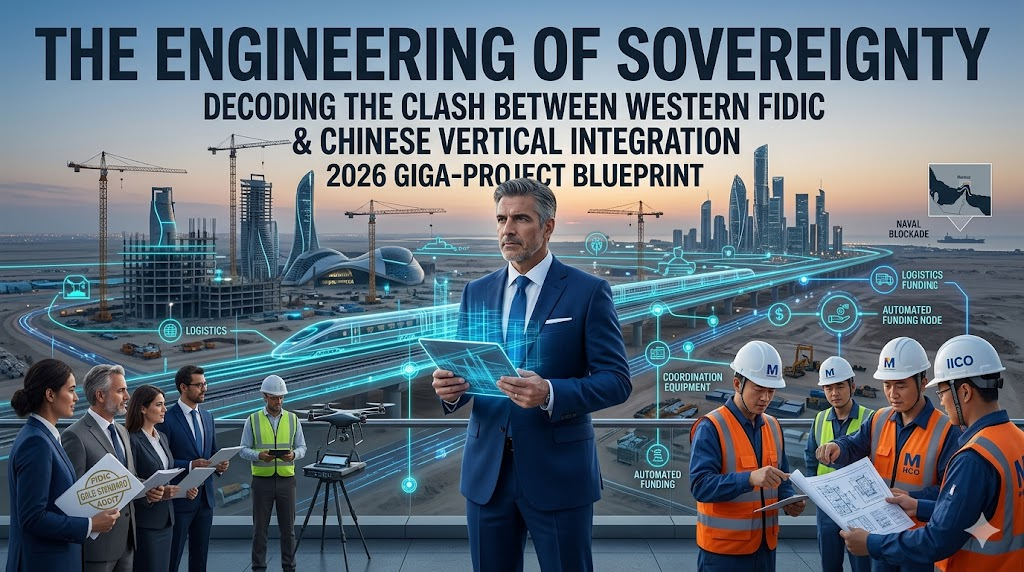
𝗧𝗵𝗲 𝗘𝗻𝗴𝗶𝗻𝗲𝗲𝗿𝗶𝗻𝗴 𝗼𝗳 𝗦𝗼𝘃𝗲𝗿𝗲𝗶𝗴𝗻𝘁𝘆
𝗗𝗲𝗰𝗼𝗱𝗶𝗻𝗴 𝘁𝗵𝗲 𝗖𝗹𝗮𝘀𝗵 𝗯𝗲𝘁𝘄𝗲𝗲𝗻 𝗪𝗲𝘀𝘁𝗲𝗿𝗻 𝗙𝗜𝗗𝗜𝗖 𝗮𝗻𝗱 𝗖𝗵𝗶𝗻𝗲𝘀𝗲 𝗩𝗲𝗿𝘁𝗶𝗰𝗮𝗹 𝗜𝗻𝘁𝗲𝗴𝗿𝗮𝘁𝗶𝗼𝗻
Manifesto Outline
- 1. Infrastructure as a Digital Ledger
- 2. The 1957 Gold Standard: The Umpire as Guardian
- 3. The Tempo Mismatch: Colliding with Velocity
- 4. Physics of Failure vs. Logic of Law
- 5. The Evolution of IICO: Closing the Loop
- 6. The Two Internets: A Fractured Digital Reality
- 7. The Fire Test: Giga-Projects in the Shadow of War (2026)
- 8. The Gulf Hybrid: The Blueprint for 2026
- 9. Conclusion: The UGM21 Mandate
1. 𝗜𝗻𝗳𝗿𝗮𝘀𝘁𝗿𝘂𝗰𝘁𝘂𝗿𝗲 𝗮𝘀 𝗮 𝗗𝗶𝗴𝗶𝘁𝗮𝗹 𝗟𝗲𝗱𝗴𝗲
In the high-stakes landscape of 2026, the traditional view of infrastructure as mere bricks and mortar has become a strategic liability. We have entered an era where an asset’s value is no longer measured solely by its tonnage of concrete but by its capacity to exist as a physical manifestation of 𝗗𝗶𝗴𝗶𝘁𝗮𝗹 𝗦𝗼𝘃𝗲𝗿𝗲𝗶𝗴𝗻𝘁𝘆. The modern 𝗦𝘂𝗽𝗲𝗿-𝗖𝗹𝗶𝗲𝗻𝘁, whether a sovereign wealth fund or a giga project entity, no longer buys a road. They buy an integrated lifecycle where data, capital, and execution operate within a single, high velocity loop.
1.1 From Static Assets to Programmable Reality
The transition from static assets to programmable reality marks a fundamental redefinition of what infrastructure represents in the modern era. In the twentieth century, infrastructure was engineered to reach a state of completion, after which its role was largely passive. A bridge, a road, or a power plant was considered successful once it met its design specifications and was handed over for use. Today, that paradigm no longer holds. Infrastructure has evolved into a continuous system of data generation, where every structural movement, load variation, and environmental interaction is captured, transmitted, and recorded. The asset is no longer a finished object; it is a living node within a broader digital ecosystem, constantly communicating its condition and performance.
This transformation introduces a new layer of governance where the physical and digital domains are inseparable. The physical structure becomes the hardware, while the embedded data architecture functions as the operating system governing its lifecycle. Decisions that were once made periodically through manual inspection are now informed in real time through telemetry, digital twins, and integrated data platforms. This shift enables a move from reactive maintenance to predictive and even autonomous intervention. In this programmable reality, infrastructure is no longer managed through documents and delayed certifications but through continuous verification, where truth is established through data streams rather than retrospective validation.
1.2 The Convergence of Data and Capital
The convergence of data and capital represents a structural shift in how infrastructure is financed and governed. In the traditional model, financial flows followed physical verification, creating a deliberate lag between execution and payment. This lag was not accidental; it was designed to ensure accountability through human oversight. However, in a high-velocity environment, this separation has become a source of friction. The modern project is no longer a sequence of isolated milestones but a continuous stream of measurable activity, where data becomes the primary validator of progress.
In this new configuration, the project evolves into a living financial ledger, where each physical action is mirrored by a digital event. Sensors, satellite feeds, and integrated monitoring systems continuously record site activity, transforming construction into a real-time dataset. Capital is no longer released based on retrospective certification but triggered through predefined conditions embedded within the system. When a threshold is met, whether structural completion, material placement, or operational readiness, the financial system responds automatically. This creates a synchronized loop where execution and funding operate in parallel rather than in sequence.
Yet this compression of verification and payment introduces a new dimension of governance risk. When capital begins to move at the , the integrity of the underlying data becomes the critical point of control. The question is no longer whether a milestone has been achieved, but whether the system verifying that milestone can itself be trusted. This shifts the role of governance from manual validation to the design, audit, and protection of the digital architecture. In this sense, sovereignty is no longer defined only by ownership of assets, but by ownership of the mechanisms that determine when and how value is released.
For the 𝗦𝘂𝗽𝗲𝗿-𝗖𝗹𝗶𝗲𝗻𝘁, the separation between financial flows and physical progress has been eliminated. By treating the project as a ledger, funding is no longer released through the friction heavy cycles of manual verification and analogue umpire approvals. Instead, automated funding triggers are hardcoded into the project’s digital twin. When the code confirms a milestone on site through satellite and sensor telemetry, the capital moves instantly. This is the death of payment friction and the birth of 𝗩𝗶𝗿𝘁𝘂𝗮𝗹 𝗩𝗲𝗹𝗼𝗰𝗶𝘁𝘆.
1.3 Sovereignty in the Virtual Domain
Digital sovereignty is no longer an abstract policy aspiration; it is an engineering reality. The ability to own and control the data that governs infrastructure has become as critical as owning the physical asset itself.
In a fragmented global system, dependence on external digital architectures introduces a silent but decisive vulnerability. When infrastructure is managed through black box platforms, proprietary algorithms, or foreign controlled data environments, the state loses visibility over its own assets. The consequence is not merely technical, but sovereign. Decisions regarding maintenance cycles, performance thresholds, and even revenue optimization begin to drift outside national control. Owning the ledger therefore means more than storing data; it means controlling the logic that interprets that data. It ensures that the truth of the asset’s condition is not filtered through external systems, but remains directly accessible, auditable, and actionable. This transforms infrastructure from a passive liability into an active instrument of state capacity, where long term durability, operational continuity, and financial integrity are governed from within rather than outsourced to unseen layers of code.
1.4 The High Velocity Governance Loop
The High Velocity Governance Loop represents a decisive shift from fragmented oversight to integrated control. In the traditional model, the investor, the builder, and the operator functioned as sequential actors, each dependent on delayed verification before the next step could begin. This created a linear chain of dependency where time gaps accumulated and accountability was distributed across documents rather than anchored in reality. The new model collapses this separation into a single, continuous system where investment, execution, and operation are synchronized within a unified framework. The project is no longer managed through periodic certification but through a real time ledger of truth, where every action is recorded, verified, and acted upon without delay.
In this integrated loop, governance is no longer an external supervisory layer but an embedded function of the system itself. Every physical activity on site is mirrored instantly within the digital ledger, creating a forensic trail of accountability that is internal, automated, and continuously auditable. This eliminates the traditional pause between completion and validation, allowing capital and execution to move in parallel. Yet the true strength of this model lies not only in speed, but in control of the verification logic. When the state or the Super Client owns the loop, it owns the conditions under which truth is established and value is released. This is where velocity transforms into sovereignty. The loop does not merely accelerate delivery; it redefines governance as a function of data integrity, system design, and continuous verification, enabling what can now be understood as Perfection in Execution in an era defined by volatility and scale.
2. 𝗧𝗵𝗲 𝟭𝟵𝟱𝟳 𝗚𝗼𝗹𝗱 𝗦𝘁𝗮𝗻𝗱𝗮𝗿𝗱
The birth of the 𝗙𝗜𝗗𝗜𝗖 𝗥𝗲𝗱 𝗕𝗼𝗼𝗸 in 1957 marked the civilizational maturity of infrastructure governance. It established what we recognize as the 𝗧𝗿𝗶𝗽𝗮𝗿𝘁𝗶𝘁𝗲 𝗦𝗮𝗻𝗰𝘁𝗶𝘁𝘆, a system designed to bring order to the chaos of post war reconstruction. While this framework served as the gold standard for decades, the modern era has transformed its once protective layers into a source of fatal friction.
2.1 The Architecture of Tripartite Sanctity
The 1957 system was founded on the rigid separation of three distinct entities. The Employer provided the vision and capital, the Contractor provided the labor and mobilization, and the Engineer acted as the neutral supervisor. This tripartite structure was designed to ensure that no single party could compromise the technical integrity of the project for financial or political gain.
2.2 The Engineer as the Analogue Umpire
The architecture of tripartite sanctity was not an administrative convenience; it was a deliberate institutional design rooted in the need to protect technical truth. By separating the roles of the Employer, the Contractor, and the Engineer, the 1957 framework ensured that no single actor could dominate the project’s outcome. Each entity operated within a defined boundary, creating a system of controlled tension where financial intent, execution capability, and technical verification were held in balance. This separation was essential in a post-war world where reconstruction required not only speed, but trust in the durability and integrity of the assets being delivered.
At its core, this structure functioned as an early form of governance engineering. The Employer defined the vision and funded the project, the Contractor translated that vision into physical reality, and the Engineer acted as an independent arbiter of truth, validating that reality against the technical specification. This created a disciplined chain of accountability where every decision was subject to external verification. In doing so, the system elevated the technical specification above commercial pressure, ensuring that infrastructure was built to endure rather than merely to satisfy immediate financial objectives. It was this institutional rigor, anchored in separation, that allowed the 1957 model to become the global benchmark for infrastructure delivery for decades.
2.3 Institutional Rigor through Separation
The strength of the 1957 framework lay in its reliance on institutional rigor rather than personal trust. By enforcing a structured separation between the Paymaster and the Contractor, the system ensured that financial authority could not directly influence physical execution. Every claim, every variation, and every interim payment was subjected to a formal process of scrutiny, where documentation served as the primary vehicle of accountability. This deliberate layering of procedure created a controlled environment in which transparency was not assumed, but engineered through mandatory checks and recorded evidence.
At a deeper level, this separation functioned as a governance mechanism that elevated the technical specification above all competing interests. The Engineer, acting as the analogue umpire, did not merely certify progress; he safeguarded the integrity of the asset against the pressures of cost, time, and political urgency. This created a system where truth was established through verification rather than negotiation, and where the durability of the infrastructure was protected from short term compromise. It was this disciplined commitment to independent validation that allowed the 1957 model to maintain credibility across jurisdictions, making it a trusted global standard for decades.b
2.4 The Era of Linear Progress
The legacy of the analogue system was never its speed, it was its discipline. By enforcing a strict separation between capital, execution, and verification, it ensured that infrastructure was built to endure, not merely to be delivered. However, in today’s high-velocity environment, that same discipline must evolve. When verification remains bound to manual processes while capital operates at digital speed, the system creates friction that compounds over time, ultimately constraining delivery rather than protecting it.
The lesson is not to discard the past, but to extract its core principle and redeploy it within a new architecture. The protection of technical integrity must remain absolute, but the mechanism of enforcement must transition from human-paced deliberation to data-driven validation. This is the pivot point: from procedural control to integrated accountability. Only by embedding engineering truth directly into the execution loop can we achieve both durability and velocity without compromise.
2.5 The Guardian of the Technical Specification
2.6 The Emergence of Procedural Friction
The strength of the 1957 system lay in its deliberate pace, but this same characteristic became its greatest liability in the age of high-velocity capital. As global investment accelerated and infrastructure demand intensified, the manual checkpoints that once ensured rigor began to generate systemic drag. Each certification cycle, each layered approval, and each independent verification introduced time delays that compounded across the project lifecycle. What was originally designed as a safeguard for quality gradually evolved into a constraint on delivery, creating a widening gap between financial commitment and physical execution.
This friction was not merely administrative, it was structural. The analogue umpire, operating at human speed, could not synchronize with a world where capital moved instantly and decisions were expected in real time. The result was a growing tension between institutional rigor and operational tempo. Investors began to perceive the very mechanisms of protection as obstacles, while engineers remained bound to processes that prioritized certainty over speed. This mismatch marked the beginning of a systemic imbalance, where the governance framework itself started to undermine the efficiency it was meant to support.
Over time, what had once functioned as a protective firewall transformed into a bureaucratic bottleneck. Projects slowed, costs escalated, and opportunities migrated toward systems that could deliver with greater velocity. The emergence of procedural friction was therefore not a failure of engineering, but a failure of synchronization. It signaled the end of an era in which time was abundant, and the beginning of a new paradigm where speed, integration, and real-time validation would define the next generation of infrastructure governance.
2.7 From Protection to Stasis
By the turn of the millennium, the separation of powers began to lead toward procedural stasis. The requirement for independent verification for every minor sub clause created a window of time that the global market could no longer afford. The gold standard, while still technically perfect, started to fail the requirement of speed, setting the stage for the great pivot toward integration.
The FIDIC Red Book established the 𝗧𝗿𝗶𝗽𝗮𝗿𝘁𝗶𝘁𝗲 𝗦𝗮𝗻𝗰𝘁𝗶𝘁𝘆. For decades, the separation between Employer, Contractor, and Analogue Umpire (Engineer) ensured rigor. Today, that separation is a source of fatal friction.
3. 𝗧𝗵𝗲 Tempo Mismatch. Colliding with Velocity
The primary crisis of modern infrastructure is not a lack of capital or engineering talent. It is a fundamental 𝗧𝗲𝗺𝗽𝗼 𝗠𝗶𝘀𝗺𝗮𝘁𝗰𝗵. We are attempting to manage 21st-century capital velocity with 20th-century legal tools. When the rapid flow of global investment hits the wall of analogue governance, the resulting collision creates a vacuum of progress that the Global South can no longer afford to ignore.
3.1 The Acceleration of Global Capital
In the current era, sovereign wealth funds and private equity no longer operate within the slow, predictable cycles that defined the 20th century. Capital has transformed into a high-velocity, borderless force, moving instantly across geographies in search of efficiency, certainty, and return. This liquidity does not tolerate delay.
3.2 Procedural Stasis as a Terminal Risk
What the traditional framework celebrates as due process, the modern investor experiences as procedural stasis. In an environment where capital is deployed at digital speed, every delay introduced by manual certification, layered approvals, and fragmented accountability directly erodes value. A week waiting for an independent Engineer’s determination is no longer a neutral administrative interval; it is a measurable financial loss, compounding against internal rate of return and investor confidence. Time, in the 2026 economy, has become the most expensive and unforgiving input.
At its extreme, procedural stasis becomes terminal. A project that cannot maintain tempo under capital pressure does not merely slow down; it loses relevance. Opportunities migrate to systems that can deliver with speed and certainty, leaving behind assets trapped in cycles of verification without execution. The implication is clear: in the modern infrastructure landscape, governance must evolve from a model of sequential approval to one of integrated, real time validation, where control is maintained not through delay, but through synchronized intelligence.
3.3 The Failure of the Analogue Bottleneck
The analogue umpire was engineered for a world where deliberation was a virtue and time was abundant. Its strength lay in its methodical nature, relying on physical signatures, paper trails, and periodic site inspections to validate progress. In the mid twentieth century, this approach ensured that every decision carried weight and accountability. However, what once functioned as a protective filter has now become a structural limitation. The sheer scale and complexity of modern giga projects have outgrown the capacity of human paced verification.
3.4 Infrastructure at the Speed of Code
The next evolution of infrastructure is defined by a single, uncompromising demand: synchronization between execution and verification. In the legacy model, construction and certification existed as two separate phases, divided by time, paperwork, and human intervention. In the high velocity economy, this separation is no longer viable. Modern systems are being designed so that verification is embedded directly into execution, allowing every action on site to be simultaneously recorded, validated, and approved within the same digital moment. This is what it means for infrastructure to move at the speed of code.
4. 𝗣𝗵𝘆𝘀𝗶𝗰𝘀 𝗼𝗳 𝗙𝗮𝗶𝗹𝘂𝗿𝗲 𝘃𝘀. 𝗟𝗼𝗴𝗶𝗰 𝗼𝗳 𝗟𝗮𝘄
The most dangerous gap in modern engineering is the distance between a signed certificate and the actual condition of the pavement. While the 𝗟𝗼𝗴𝗶𝗰 𝗼𝗳 𝗟𝗮𝘄 seeks to assign blame and protect liability, the 𝗣𝗵𝘆𝘀𝗶𝗰𝘀 𝗼𝗳 𝗙𝗮𝗶𝗹𝘂𝗿𝗲 remains indifferent to contractual arguments. A road does not fail because a clause was misinterpreted; it fails because the material properties were compromised.
4.1 The Indifference of Physical Laws
Physical reality operates on a set of immutable laws that remain completely indifferent to contracts, negotiations, or institutional authority. Gravity, moisture infiltration, thermal expansion, and material fatigue do not recognize the language of clauses or the intent of compliance certificates. A pavement subjected to overload will deteriorate, whether or not the paperwork declares it compliant. This indifference is the most fundamental truth in engineering: nature does not negotiate.
The danger arises when governance systems begin to prioritize legal validation over physical verification. In such environments, a project may achieve full contractual compliance while simultaneously moving toward structural failure. This creates a false equilibrium where stakeholders believe the asset is secure simply because it has passed procedural checks. In reality, the environment is continuously testing the structure, exposing every deviation from the technical specification in real time. When the Logic of Law overrides the Physics of Failure, the system becomes blind to the very forces that determine the asset’s survival.
4.2 The Fourth Power Law of Decay
The degradation of infrastructure is not a matter of opinion or contractual interpretation; it is governed by mathematical certainty. The Fourth Power Law establishes that the damage inflicted on a pavement by a vehicle increases exponentially with its axle load. This means that a marginal increase in load does not produce a marginal increase in damage, but a disproportionately large one. A truck carrying twice the permissible axle load does not cause twice the damage; it can cause up to sixteen times more deterioration. This is the brutal arithmetic of physical systems, where small deviations compound into catastrophic consequences.
4.3 Legal Compliance as a False Metric
In the traditional project ecosystem, success is often defined by the completion of procedural checkpoints. If all forms are signed, inspections recorded, and certificates issued, the project is deemed compliant. However, this creates a dangerous illusion. Legal compliance is a static snapshot, capturing only whether a process was followed at a given moment in time. It does not measure whether the underlying asset is structurally sound, resilient, or capable of surviving its intended lifecycle.
This disconnect becomes critical in high-velocity environments where documentation can outpace physical reality. A structure may be declared “complete” on paper while already deviating from its technical specification due to unnoticed execution flaws or material compromises. The system rewards the completion of paperwork rather than the integrity of the asset, allowing projects to achieve legal perfection while drifting toward physical failure. This is how infrastructure becomes “legally certified but technically vulnerable.” To restore balance, engineering governance must shift from compliance-based validation to performance-based verification. The true metric of success is not whether a clause has been satisfied, but whether the asset performs under real-world conditions over time. This requires integrating continuous monitoring, data-driven validation, and lifecycle accountability into the governance framework. Only then can we move beyond the illusion of compliance and anchor decision-making in the physics of performance rather than the comfort of documentation.
4.4 Toward a Unified Forensic Framework
The next evolution of infrastructure governance requires a decisive shift from fragmented oversight to a unified forensic framework where law is subordinate to physics, and documentation is anchored in reality. In this model, the traditional separation between legal validation and engineering truth is eliminated. Instead of relying on periodic human certification, the system operates on a continuous stream of real-time verification, where every material input, structural response, and execution milestone is recorded within a Digital Ledger. This transforms governance from a reactive process into a living, evidence-based system that reflects the asset as it truly exists, not as it is reported.
5. 𝗧𝗵𝗲 Evolution of IICO. Closing the Loop
The emergence of 𝗜𝗜𝗖𝗢 (Integrated Investment, Construction, and Operation) represents a tectonic shift in how the Global South conceptualizes infrastructure. By collapsing the fragmented silos of the 20th century into a singular, unified delivery machine, this model moves beyond the mere "provision of an asset" toward the "guarantee of a functional outcome." It is the ultimate evolution of the state as a mother entity, ensuring that the loop of accountability is closed from the first dollar invested to the last kilometer of maintenance.
5.1 The Strategic Collapse of Procurement Silos
In the traditional tripartite model, the handoff between the designer, the builder, and the operator is often a point of catastrophic data loss. Each transition creates a contractual boundary where information is filtered, distorted, or discarded to protect individual liability. IICO eliminates these boundaries by placing the entire lifecycle under a single umbrella of responsibility. This vertical integration ensures that the entity building the road is the same entity that must maintain it for the next thirty years, effectively aligning the builder’s short term profit with the asset’s long term durability.
This collapse of silos also transforms the nature of risk. Instead of the Employer bearing the brunt of unforeseen site conditions and the Contractor seeking variations to increase margins, the IICO model internalizes these conflicts. When the investor and the builder are part of the same integrated system, the "Logic of Law" that governs disputes is replaced by the "Logic of Efficiency." The goal is no longer to win a legal argument but to ensure the project remains viable and profitable over its entire operational life.
Ultimately, this integration allows for a level of technical continuity that was previously impossible. Every decision made during the construction phase is informed by the operational requirements of the future. The materials chosen, the compaction levels achieved, and the drainage systems installed are all viewed through the lens of thirty year performance. This is the death of the "Lowest Bidder" mentality, replaced by a sophisticated understanding of total cost of ownership.
5.2 Financial Necessity as an Accountability Driver
The brilliance of the IICO model lies in its reliance on integrated state banking and toll revenue as the primary enforcement mechanism. In an analogue system, a contractor is paid for "Work Done" regardless of whether that work will survive the first monsoon. Under IICO, the return on investment is directly tied to the asset's ability to generate revenue through operations. If the pavement fails, the toll revenue drops, and the internal financing mechanism suffers. This creates a self regulating system of accountability that is far more powerful than any external audit.
By leveraging integrated finance, the Super-Client can bypass the traditional "Payment Friction" that plagues infrastructure projects. Funds move at the speed of site progress because the paymaster has a direct, vested interest in the velocity of execution. There is no longer a need for a three month delay while an independent consultant verifies a certificate. The system itself is the verification. The data from the site flows directly into the financial ledger, triggering payments based on verified physical milestones captured by the digital twin.
This financial integration also provides a shield against the "Maintenance Mirage." In many developing nations, infrastructure is built with great fanfare only to be abandoned to the elements due to a lack of recurring budgets. IICO solves this by hardcoding maintenance into the initial financial structure. The revenue generated by the asset is legally and operationally ring fenced to ensure its own survival. The loop is closed because the asset is engineered to pay for its own existence, removing the burden from the national treasury.
5.3 The Mother State as System Integrator
The final evolution of IICO is the transformation of the nation from a passive "Paymaster" into a sophisticated "System Integrator." In this role, the state no longer stands on the sidelines watching a foreign contractor build a black box asset. Instead, the state owns the digital core of the project. It sets the technical standards, monitors the real time data, and manages the integration of various technology partners. This is the highest form of engineering sovereignty, where the state maintains the keys to its own critical infrastructure.
This model allows for a unique blend of global expertise and local control. A nation can bring in the "Chinese IICO Machine" for its sheer delivery muscle while maintaining a "Western Consultancy" layer for high level audit and verification. The state acts as the master conductor, ensuring that the velocity of the East and the rigor of the West are harmonized within its own sovereign framework. The Result is a hybrid system that is faster than the traditional model and more accountable than a closed loop delivery.
By acting as the system integrator, the Mother State ensures that the knowledge gained during the project is retained within the national border. The data generated by the digital twin becomes a national asset, informing future giga projects and creating a local ecosystem of high tech engineering talent. This is how a nation moves from being a consumer of foreign technology to a producer of its own development. The closed loop of IICO is not just about the asset; it is about the long term growth of the nation’s intellectual and industrial capacity.
6. 𝗧𝗵𝗲 Two Internets. A Fractured Digital Reality
We are no longer living in a world of a singular, unified digital infrastructure. The global engineering landscape has split into two distinct operating systems, creating a 𝗙𝗿𝗮𝗰𝘁𝘂𝗿𝗲𝗱 𝗗𝗶𝗴𝗶𝘁𝗮𝗹 𝗥𝗲𝗮𝗹𝗶𝘁𝘆. On one side is the Western-Centric model, built on legalism and paper-based verification. On the other is the Chinese-Dominant model, built on vertical integration and the velocity of code. For the Global South, choosing between these two is not just a procurement decision; it is a choice of which "Internet of Infrastructure" will govern their national development. The future lies in establishing the bridge in between the two internets, in any domain the thinking will channalise according to the choice of the web amanah21.com is an example to act as a bridge between the Global North and Global South.
6.1 The Western-Centric Internet of Law and Paper
The Western model operates on an "Analogue Internet" where the primary currency is the legal document. Verification is slow because it relies on independent, third-party humans to sign off on physical milestones. This system is designed for high-trust, low-velocity environments where the "Gold Standard" is defined by how well the paperwork matches the contract. However, in the age of giga-projects, this leads to massive data fragmentation. Information is trapped in PDFs, emails, and physical filing cabinets, creating a "Latency Gap" that makes real-time project management impossible.
6.2 The Chinese-Dominant Internet of Integrated Code
In stark contrast, to the Western analogue framework, the Chinese model represents a fundamental architectural shift from documentation to computation. It is not built on contracts as the primary medium of trust, but on integrated digital systems where execution and verification are inseparable. Within this paradigm, the infrastructure project itself becomes a live operating system, where every activity on site is translated into data and fed into a centralized command structure. The traditional boundaries between investor, contractor, and operator dissolve into a single, vertically integrated entity, creating a system designed for maximum velocity and minimum friction.
6.3 The Bifurcation of Technical Standards
This fracture is not merely institutional or philosophical; it penetrates directly into the technical DNA of infrastructure itself. We are witnessing the emergence of two fundamentally different definitions of truth in engineering practice. In the Western paradigm, truth is established through the independent determination of the Engineer, validated by compliance with documented specifications and contractual procedures. In the Eastern, integrated system, truth is derived from continuous system telemetry, where performance is measured, recorded, and validated in real time through embedded sensors and automated analytics. These are not complementary approaches; they are competing epistemologies of engineering reality.
6.4 Geopolitical Sovereignty in the Fragmented Stack
The most profound analysis of this section is the realization that 𝗗𝗶𝗴𝗶𝘁𝗮𝗹 𝗦𝗼𝘃𝗲𝗿𝗲𝗶𝗴𝗻𝘁𝘆 now depends on which "Stack" a nation adopts. If a nation is locked into a "Closed Loop" Chinese system, it gains incredible velocity but risks losing control over its long-term data and maintenance path. If it stays purely within the Western "Paper" system, it maintains high legal transparency but risks falling behind in the global race for development due to procedural stasis. The challenge for 2026 is to engineer a "Middle-Ware" governance layer—a way to bridge these two internets so that a nation can own the velocity of the East without sacrificing the audit standards of the West.
7. 𝗧𝗵𝗲 𝗙𝗶𝗿𝗲 𝗧𝗲𝘀𝘁: 𝗚𝗶𝗴𝗮-𝗣𝗿𝗼𝗷𝗲𝗰𝘁𝘀 𝗶𝗻 𝘁𝗵𝗲 𝗦𝗵𝗮𝗱𝗼𝘄 𝗼𝗳 𝗪𝗮𝗿 (𝟮𝟬𝟮𝟲)
The geopolitical landscape of 2026 has provided the ultimate stress test for the modern infrastructure model. The escalation of conflict in the Middle East and the blockade of the 𝗦𝘁𝗿𝗮𝗶𝘁 𝗼𝗳 𝗛𝗼𝗿𝗺𝘂𝘇 have moved the conversation from "Efficiency" to "Survival." For the 𝗦𝘂𝗽𝗲𝗿-𝗖𝗹𝗶𝗲𝗻𝘁, the fire test of war has revealed that physical assets are only as valuable as the supply chains and energy security that sustain them.
7.1 The Collapse of the Safe Haven Narrative
For decades, the Gulf was positioned as a permanent sanctuary for global capital, a region insulated from the systemic volatility that defined much of the Global South. Mega and giga projects were conceived under the assumption that geopolitical stability was a given, not a variable. This perception created an artificial confidence where financial modeling ignored geopolitical fragility, and infrastructure was treated as if it existed outside the reach of conflict.
The events of 2026 have decisively shattered this illusion. The disruption of maritime corridors and the exposure of critical energy infrastructure to kinetic risk have demonstrated a harsh reality: there is no such thing as a safe haven in a connected world. When supply chains are severed and logistics corridors collapse, even the most technically perfect asset becomes functionally irrelevant. A project’s value is no longer defined by its compliance with specification, but by its ability to remain operational under systemic stress.
7.2 Emergency Procurement and the Death of Deliberation
In a theater of war, deliberation is not a virtue; it is a liability. The institutional luxury of the “Analogue Umpire” collapses under conditions where time itself becomes the scarcest resource. When a nation faces a cascading failure, food supply disruption, energy blackout, or logistical isolation; it cannot afford the latency of a six-month tender cycle or the procedural gravity of multi-tier dispute resolution. The system must act before the crisis compounds.
7.3 Redundancy as the New Sovereign Metric
The 2026 crisis has fundamentally redefined how we measure the success of an engineering project. Technical perfection, once the highest benchmark, is no longer sufficient. A road, a port, or a rail corridor that cannot function under disruption is not an asset, it is a liability. In the new paradigm, redundancy has replaced efficiency as the primary metric of sovereignty.
8. The Gulf Hybrid. The Blueprint for 2026
The recent developments in the Gulf, particularly the Giga-projects of Saudi Arabia and the UAE, serve as the global laboratory for the 𝗦𝘂𝗽𝗲𝗿-𝗖𝗹𝗶𝗲𝗻𝘁 model. These nations have successfully managed to bring the Chinese IICO delivery machine into a Western Consultancy oversight environment. They have matched the "Mother State" speed with the "Gold Standard" audit, creating a unique synthesis that is now the definitive blueprint for the Global South in 2026.
8.1 The Laboratory of the Super-Client
The Gulf has moved beyond the role of a passive financier. By acting as the primary system integrator, these nations have transformed their procurement departments into high-tech command centers. They do not merely hire contractors; they engineer the environment in which those contractors must perform. This laboratory has proven that a nation can maintain absolute control over its vision while utilizing the most aggressive delivery models available on the global market.
8.2 Harmonizing Eastern Velocity and Western Rigor
The "Gulf Hybrid" is a sophisticated middle-ware layer. It takes the vertical integration of the East, which allows for rapid mobilization and 24/7 execution, and subjects it to the forensic scrutiny of Western-style engineering audits. This creates a dual-verification system where the "Digital Ledger" of the IICO loop is constantly cross-referenced against the "Technical Specification" of the consultant. The result is a project that moves at the speed of code but remains compliant with international gold standards.
8.3 Lowering the Price of Infrastructure via the Virtual Domain
By delivering everything in the 𝗩𝗶𝗿𝘁𝘂𝗮𝗹 𝗗𝗼𝗺𝗮𝗶𝗻 first, the Gulf states have effectively lowered the cost of physical infrastructure. The use of advanced Digital Twins allows for the simulation of every stress test, every logistical bottleneck, and every material failure before a single cubic meter of concrete is poured. This "Digital First" approach reduces the expensive variation orders and site delays that typically plague traditional FIDIC-based projects, ensuring that the final asset is both high-spec and cost-efficient.
8.4 Engineering Digital Sovereignty
These nations are not waiting for the West to update 𝗙𝗜𝗗𝗜𝗖 𝗖𝗹𝗮𝘂𝘀𝗲 𝟮𝟭, nor are they blindly accepting a "Closed Loop" delivery that they cannot control. Instead, they are engineering their own digital sovereignty. By owning the data stack and the project software, the Gulf states ensure that the long-term maintenance and operational intelligence of their giga-projects remain a national asset. They have proven that being a "Paymaster" and a "System Integrator" simultaneously is the only way to protect a nation's future interests.
8.5 The Exportable Blueprint for 2026
The Gulf Hybrid is no longer an isolated experiment; it is an exportable blueprint for any nation in the Global South seeking to break free from procedural stasis. It offers a way to navigate the fractured digital reality of the two internets by creating a sovereign third path. This model demonstrates that with the right governance framework, a country can achieve perfection in execution and high-tempo growth, even in the shadow of regional volatility and global economic shifts.
9. 𝗖𝗼𝗻𝗰𝗹𝘂𝘀𝗶𝗼𝗻: 𝗧𝗵𝗲 𝗨𝗚𝗠𝟮𝟭 𝗠𝗮𝗻𝗱𝗮𝘁𝗲
The forensic journey from the 1957 Gold Standard to the 2026 Super-Client archetype reveals a fundamental truth: infrastructure is no longer a static physical asset but a dynamic digital ledger. The transition from the 𝗔𝗻𝗮𝗹𝗼𝗴𝘂𝗲 𝗨𝗺𝗽𝗶𝗿𝗲 to the 𝗦𝘆𝘀𝘁𝗲𝗺 𝗜𝗻𝘁𝗲𝗴𝗿𝗮𝘁𝗼𝗿 is not merely a change in procurement; it is a necessary evolution for national survival in a high-velocity, fractured world.
9.1 The Death of Procedural Stasis
The tripartite sanctity of the 20th century, while architecturally rigorous, has collided with the terminal reality of 𝗧𝗲𝗺𝗽𝗼 𝗠𝗶𝘀𝗺𝗮𝘁𝗰𝗵. In an era where capital moves at the speed of code, the Global South can no longer afford the "Protection of the Clause" at the expense of "Velocity of Execution." The 1957 model must be upgraded from a manual bottleneck into an automated, data-driven framework of accountability.
9.2 Harmonizing the Two Internets
The bifurcation of the global engineering stack into Western Legalism and Eastern Integration is the defining challenge of 2026. Sovereignty now depends on the ability to bridge these 𝗧𝘄𝗼 𝗜𝗻𝘁𝗲𝗿𝗻𝗲𝘁𝘀. By adopting a "Middle-Ware" governance layer, nations can utilize the delivery muscle of the IICO loop while maintaining the forensic audit standards required to protect the long-term integrity of the technical specification.
9.3 The Fire Test as a Catalyst
The 2026 Middle East conflict and the Hormuz blockade have proven that resilience is the only metric that matters during a "Black Swan" event. Infrastructure must be redundant, distributed, and managed within the 𝗩𝗶𝗿𝘁𝘂𝗮𝗹 𝗗𝗼𝗺𝗮𝗶𝗻. The fire test has moved the "Super-Client" model from a luxury of the wealthy to a survival mandate for any nation facing regional volatility and supply chain fragility.
9.4 Pavement Pathology over Contractual Fiction
We must return to the 𝗣𝗵𝘆𝘀𝗶𝗰𝘀 𝗼𝗳 𝗙𝗮𝗶𝗹𝘂𝗿𝗲 as our primary guide. Engineering excellence cannot be achieved through the "Logic of Law" alone. By closing the loop between investment, construction, and thirty-year operations, we eliminate the maintenance mirage. We ensure that the asset is engineered to survive the environment, not just the audit, by making the builder the ultimate stakeholder in the asset's performance.
9.5 The Mandate: Own the Velocity
The message for the infrastructure leaders of 2026 is absolute: 𝗗𝗼𝗻'𝘁 𝗷𝘂𝘀𝘁 𝗯𝘂𝗶𝗹𝗱; 𝗜𝗻𝘁𝗲𝗴𝗿𝗮𝘁𝗲. To secure a nation's future, the state must transition from a passive paymaster to a sophisticated system integrator. The future of the Global South does not belong to those who wait for a signed certificate, but to those who engineer their own digital sovereignty and 𝗢𝘄𝗻 𝘁𝗵𝗲 𝗩𝗲𝗹𝗼𝗰𝗶𝘁𝘆 of their own development.

𝗗𝗼𝗻'𝘁 𝗷𝘂𝘀𝘁 𝗯𝘂𝗶𝗹𝗱, 𝗜𝗻𝘁𝗲𝗴𝗿𝗮𝘁𝗲. The future belongs to those who own the velocity of their own development.
Links to UGM Articles and Newsletters:
LinkedIn: Newsletter Medium: ORCHID ID:
Blogspot & Medium articles:
Mineral Wealth and Institutional Maturity. A Global South Prespective
The Ethical Regulator. Beyond the Mechanical Trap of Law and Logic
Infrastructure Governance and Dispute Avoidance in the Global South
𝗔𝗜 𝗮𝘀 𝗮 𝗣𝗼𝗲𝘁 𝗼𝗿 𝗮 𝗪𝗶𝘁𝗻𝗲𝘀𝘀. 𝗔 𝗣𝗿𝗮𝗰𝘁𝗶𝗰𝗮𝗹 𝗠𝗲𝗱𝗶𝘁𝗮𝘁𝗶𝗼𝗻 𝗼𝗻 𝗧𝗿𝘂𝘁𝗵
𝗧𝗵𝗲 𝗦𝘁𝗿𝗮𝗶𝗴𝗵𝘁 𝗪𝗮𝘆 𝘁𝗼 𝗚𝗹𝗼𝗯𝗮𝗹 𝗦𝘁𝗮𝗯𝗶𝗹𝗶𝘁𝘆
Forensic Definitions:
𝗗𝗶𝗴𝗶𝘁𝗮𝗹 𝗟𝗲𝗱𝗴𝗲𝗿: The decentralized, immutable record of an infrastructure asset’s entire lifecycle. It moves beyond simple documentation to become the "Single Source of Truth," where material properties, financial triggers, and structural health are hardcoded and verifiable in real-time.
𝗦𝘂𝗽𝗲𝗿-𝗖𝗹𝗶𝗲𝗻𝘁: A high-velocity sovereign or private entity (such as a Sovereign Wealth Fund) that acts as a System Integrator. Unlike a traditional employer, the Super-Client collapses the roles of investor, builder, and operator to maintain absolute control over the asset’s velocity and data.
𝗧𝗿𝗶𝗽𝗮𝗿𝘁𝗶𝘁𝗲 𝗦𝗮𝗻𝗰𝘁𝗶𝘁𝘆: The rigid separation of powers established by the 1957 FIDIC model between the Employer, the Contractor, and the Engineer (Analogue Umpire). While originally designed for institutional rigor, it often leads to procedural stasis in modern Giga-projects.
𝗔𝗻𝗮𝗹𝗼𝗴𝘂𝗲 𝗨𝗺𝗽𝗶𝗿𝗲: The traditional role of the Engineer under FIDIC who manually verifies site conditions and signs off on paper certificates. In a high-velocity environment, this role often becomes a bottleneck due to the reliance on human-speed deliberation.
𝗜𝗜𝗖𝗢 (𝗜𝗻𝘁𝗲𝗴𝗿𝗮𝘁𝗲𝗱 𝗜𝗻𝘃𝗲𝘀𝘁𝗺𝗲𝗻𝘁, 𝗖𝗼𝗻𝘀𝘁𝗿𝘂𝗰𝘁𝗶𝗼𝗻, 𝗮𝗻𝗱 𝗢𝗽𝗲𝗿𝗮𝘁𝗶𝗼𝗻): A vertically integrated delivery model where a single entity (or state machine) owns the entire lifecycle of an asset. It prioritizes operational outcomes and long-term durability over short-term contractual milestones.
𝗣𝗿𝗼𝗰𝗲𝗱𝘂𝗿𝗮𝗹 𝗦𝘁𝗮𝘀𝗶𝘀: A state of project paralysis caused by excessive bureaucratic checks, manual verification cycles, and fragmented legal governance. It represents a terminal risk to the internal rate of return (IRR) for modern investors.
𝗣𝗮𝘃𝗲𝗺𝗲𝗻𝘁 𝗣𝗮𝘁𝗵𝗼𝗹𝗼𝗴𝘆: The forensic study of how physical materials (specifically in road and infrastructure engineering) interact with their environment and decay over time. It prioritizes the Physics of Failure over the Logic of Law.
𝗙𝗼𝘂𝗿𝘁𝗵 𝗣𝗼𝘄𝗲𝗿 𝗟𝗮𝘄: A mathematical principle of road engineering stating that the damage caused by a vehicle increases to the fourth power of its axle load. It serves as the physical benchmark for asset durability that no legal clause can override.
𝗧𝗵𝗲 𝗧𝘄𝗼 𝗜𝗻𝘁𝗲𝗿𝗻𝗲𝘁𝘀: The global bifurcation between the Western-Centric internet (based on paper, legalism, and fragmented oversight) and the Eastern-Dominant internet (based on integrated code, site telemetry, and financial velocity).
𝗗𝗶𝗴𝗶𝘁𝗮𝗹 𝗦𝗼𝘃𝗲𝗿𝗲𝗶𝗴𝗻𝘁𝘆: The capacity of a nation to own, control, and protect the data stack governing its critical infrastructure. It ensures that the state remains the master of its own development "OS" rather than outsourcing it to external algorithms.
𝗠𝗮𝗶𝗻𝘁𝗲𝗻𝗮𝗻𝗰𝗲 𝗠𝗶𝗿𝗮𝗴𝗲: The false assumption that an infrastructure asset is "finished" at handover. It describes the gap between a legal warranty and the physical reality of an asset that begins to decay the moment construction ends without integrated feedback loops.
PE | FCIArb | UNDP GPN ExpRes pre-vetted Global Consultant